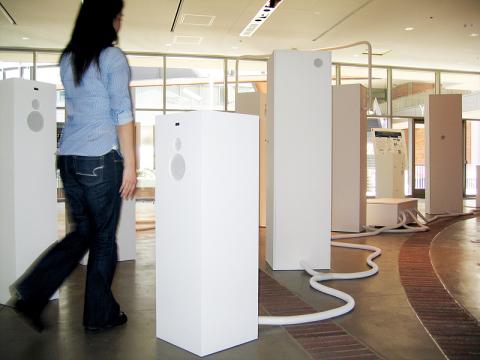
Installation

Image: 

The Value of Water

By The Reverend Canon Tom Miller

excerpt from Water Matters: Why We Need to Act Now to Save our Most Critical Resource

The exhibition, the largest to ever appear at the Cathedral, will feature the work of 41 contemporary visual artists, including Mark Rothko, Jenny Holzer, Wiliam Kentridge, Kiki Smith, Bill Viola, Pat Steir, Gregory Amenoff, and others whose work focuses on depicting and reflecting on water.

The 18th century philosopher Novalis wrote, “Our bodies are molded rivers.” Such poetic sentiment is easy to appreciate even in the less-than-poetic age in which we live. We are generally aware of our bodies as organic compositions attuned to the dynamics of nature. It is more difficult, perhaps, to think of buildings as organic bodies in quite the same way. Imagine, for instance, streams of water coursing through the seemingly solid stones of The Cathedral of St. John the Divine in New York; water rising up through the pillars like sap in a soaring forest.

Outside, the Gothic-styled Cathedral seems impressively massive, built to withstand the tempering of time. Inside, the breathtaking view from the Bronze Doors to the far end of the building presents an even more compelling vision: stone, wood and glass, all hard materials of the Earth that have been molded into an architectural body of wondrous dimension. So, where’s the water, that element that makes it a living cathedral rather than just a pile of stones?

The simple answer is that there’s water, water everywhere, as the imagination might fashion it, since none of the stone, wood or glass would exist without the presence and power of water over geological time. As biblical tradition has it, human beings bear the image of their Creator. Perhaps in like manner, all the materials in the Cathedral bear the mark of water, that first element of Creation from which all things were made.

Another simple answer is that water is at the very foundation of the Cathedral. The land on which it stands is dotted with wells, springs, and underground streams. For decades water for the Baptismal Font was drawn from one of them. So, even while we think of the building as the solid monumental body it surely is, we can also envision the water-laced land from which it rises.

Shortly there will be yet another answer to the question, “ Where’s the water in the Cathedral?” “The Value of Water,” an ambitious installation of art opens in September, 2011. Works by painters, sculptors, and media artists, including the seven presented in the following pages, will be installed in bays of the nave, in various chapels, and along the walls of the Great Crossing. As interpreters of the unseen, artists will help us to see what has been there all along; to strengthen our awareness of water, and to prompt our imaginations in the contemplation of water, from wells and underground springs to surging seas and mighty rivers. With this collection of powerful presentations, there really will be water, water everywhere.


The Cathedral Church of St. John the Divine
1047 Amsterdam Avenue
New York, New York 10025 General: 212 316-7490
Tours: 212 932-7347
info@stjohndivine.org
© 2007 Cathedral Church of Saint John the Divine


Image: 

Victoria Vesna & Jim Gimzewski: Blue Morph

Wave(form)s - an Exhibition of Electronic Art on Governors Island
May 27 through September 25
Fridays, 11am to 4:30pm
Saturdays and Sundays, 11am to 5pm
FREE
Click here to buy membership!

Location:

THE NEW YORK ELECTRONIC ART FESTIVAL St. Cornelius Chapel
Governor's Island
Free ferry service from Manhattan and Brooklyn:
http://www.govisland.com/html/visit/directions.shtml

Blue Morph by Victoria Vesna and nanoscientist Jim Gimzewski, is an interactive installation that uses nanoscale images and sounds derived from the metamorphosis of the Blue Morpho butterfly presented in historic St. Cornelius Chapel

Nanotechnology is changing our perception of life and this is symbolic in the Blue Morpho butterfly with the optics involved -- that beautiful blue color is not pigment at all but nano-photonic patterns and structure. The optics are fascinating but the real surprise is in the discovery of the way cellular change takes place in a butterfly. Sounds of metamorphosis are not gradual but rather the cellular transformation happens in sudden surges that are broken up with stillness and silence. Nano is not only making the invisible visible but also changing our way of relating to "silence" or making the in-audible audible. With all the noise of chattering technologies and minds, we propose the interactivity to be stillness for in this empty space of nano we can get in touch with the magic of continuous change. The piece fully emerges in sound and pattern only when the participant is STILL and SILENT.

Credits:

Surround sound: Paul Geluso, Sound processing: Gil Kuno, Interactivity: Paul Geluso, Tyler Adams, Miu Ling, Danaus plexippus chrysalis recording: Andrew Pelling and Paul Wilkinson, Interactive seat construction: Romie Littrell, Knitted morph hat: Silvia Rigon
Installation Designa and Coordination: Aliki Potiris, Interns: Caitlin Morris, Nick Engel, Aliza Simons
Butterfly wing imaging: Marc Castagna, Senior Application Engineer, SEM operator. Thanks to Don Kenia, CEO of FEI Corp. for permission to use the Scanning Electron Microscope.
Morpho peleides and Danaus plexippus wings and pupa provided by Dr. Richard Stringer Department of Math, Science and Allied Health, Harrisburg Area Community College.
More information about the Blue Morph: artsci.ucla.edu/BlueMorph


Image: 

By Bruce Drummond and Nick Hardeman

http://social.sqncr.com/

Location: CNSI Gallery on the 5th Floor
Beginning June 28, 2010
Gallery Hours: Monday-Friday, 10 am - 4 pm

social sqncr is an interactive audio-visual installation that aims to make people more aware of the act of creating their public identity.

To create their ‘identity’, participants use their bodies to physically interact with a pseudo-musical instrument projected in a physical space to create virtual musical creatures based on their movements. The instrument consists of eight zones that participants interact with which influence the shape, movement, and aural properties of the resulting entity.

Once complete, the system captures an image of the participant to attach to the creature which is then set free into an eco-system inhabited by similar entities. The entities react to one another, much like human beings in a social network. Participants can cause environmental disturbances by physically interacting with the projection.
The physical movements required of participants ensures a high level of investment in the process, causing a heightened awareness of their creation, and thus themselves. Watching their entity interact with other entities is a reflection of their own interaction in their social networks.

Bio:

Bruce Drummond and Nick Hardeman are both recent graduates from the MFA Design and Technology program at Parsons, in New York. They experiment with new technologies to produce immersive, interactive audio visual experiences.

Contact: http://sqncr.com/social/contact/

Image: 

Students from Professor Victoria Vesna’s 2010 graduate seminars Data + Flesh, Department of Design | Media Arts, UCLA + Hybrid Worlds: Nano_Biotech + Art Parsons The New School for Design in New York and UCLA Honors class Biotech + Art exhibit their concepts / proposals / presentations of objects, performances / art installations -- all responding to how we are changing our bodies, the food we consume, the animals we breed & the environment we inhabit.

Parsons seminar co-taught by neuroscientist Siddharth Ramakrishnan

co-sponsored by UCLA Center for Society and Genetics
supported by Leonardo ISAST + UCIRA + Parsons AMT

www.nanobioart.net

May 14 - June 7, 2010.Open Monday-Friday, 10 a.m.- 4 p.m.
Parking is $10 all day, and is available near CNSI in structure 9, adjacent to the building. For more information, call 1.310.794.2118.

Image: 

Microwave International New Media Arts Festival 2009
Hong Kong

Four water bowls reflect different aspects of water related to the collective, global human condition. Some of the most common metaphorical associations of water -- such as the reflection of the moon, a drop of water, the sound of water, and oil and water -- are revisited through the use of some of the latest scientific observations. Moon and Sound are locally interactive and Drop and Oil are interactive both locally and remotely, emphasizing the global connectivity of water / human systems, beyond borders.

Conference: November 15th, 11:00-16:00 at the Hong Kong Heritage Discovery Center Lecture Hall
Eco_Visualization: Combining Art and Technology to reduce energy consumption

Keynote lecture: November 15th, 14:00-15:00
Victoria Vesna: "Sound Thinking in Art Making: Ghosts, Quantum Tunnel & Butterflies"

Grand Opening: November 13, 2009 18:30 - 19:30
Exhibition Hall, Low Block, Hong Kong City Hall

For more info on Microwave, please visit their website: http://www.microwavefest.net/festival2009/

For video of past exhibitions of Waterbowls, please visit: https://waterbowls.victoriavesna.com/

Categories: 

Victoria Vesna + James Gimzewski collaborations NanoMandala and Zero@wavefunction on exhibit in Tenerife, Spain. Exhibition opens September 25 and runs through October 25 at El Tanque, Espacio Cultura.

NanoMandala is a videoprojection on a sand mandala created by Tibetan Buddhist monks from the Gaden Lhopa Khangsten Monastery in India. Inspired by Buddhist culture, NanoMandala examines our perceptions of the universe from the nano to the cosmic scale. Images are projected onto the sand mandala of a single grain of sand at the molecular level, evolve into images of the complete mandala. Ambient sounds for NanoMandala were created by mixing sounds of ocean waves and audio of the Tibetan monks chanting while building the sand mandala.

http://nano.arts.ucla.edu/mandala/

Zero@wavefunction is based on the manipulation of molecules through shadow in nanoscience, translated into a larger-than-life-scale projection that can be manipulated by a person's shadow. A camera captures a person's shadow and the image is projected onto representations of molecules, allowing a person to transform the structure of molecules on the nanoscale.

Categories: 

Shawcross, Location One’s first International Fellow, has produced an ambitious new work titled Slow Arc III, which demonstrates the artist’s continued interest in mathematics, cosmology and epistemology. The installation will re-open from September 9th - 26th, 2009 with special public programming.

http://www.location1.org/conrad-shawcross-control/

RE-OPENING RECEPTION:
Wednesday, September 9th, 2009, 6–8 PM
(open to the public)
DATES: September 9th - 26th, 2009
HOURS: Tuesday-Saturday 12–6 PM

Incheon International Digital Art Festival - INDAF 2009
Incheon, Korea

Victoria Vesna with Sidarth Ramkrishnan & Gil Kuno
Hox Zodiac 2009 / Interactive Installation

This interactive project is inspired by the properties of the Homeobox genes which essentially define body regions in all animals as well as humans. We seek to create experiential space that relates the idea that we are all interconnected.

The goal is to entice the audience with these fascinating genes that are responsible for many different variations of legs, arms and other parts of the body that exist in the animal kingdom. The hox gene also plays a role in many dynamic changes in human development and continues to be an important subject for scientific exploration in the areas of brain development, body patterning, and variation across species.

The audience's silhouette is generated from a video capture and connected to an abstract rendition of a hox gene. The participant influences the transfprmation into different creatures that emerge and respond to different movements. The animals correspond to the twelve signs of the Chineses zodiac that morph into new creatures and mirror the movement of the person captured. Sounds attached to the animals are composed by Gil Kuno who created a parallel 'Scopic' world to the creatures with visual sound waves on the opposing wall.

http://www.indaf.org/e_bmu02/bmu02_02_01.asp

Image: 

Opening Reception: Wed, January 14, 6-8 pm
Exhibit Dates: January 14- February 4
UCLA, CN(S)I Lobby, Parking Lot 9

*partcicle group*, Particles of Interest: Tales from the Matter Market (2006 - )

*Particles of Interest* is an interactive installation of poetic meditations from around the world that allows visitors to encounter the global chorus on nanotechnology, culture, and property. The installation creates a *sonic-simulation* of particle data scanning gestures:

Nanotechnology involves the manipulation of materials and the creation of structures and systems that exist at the scale of atoms and molecules. A nanometer (nm) is one billionth of a meter. By way of comparison, a DNA molecule is roughly 2.5 nm, a red blood cell 7,000 nm and a human hair cell a whopping 80,000 nm wide. The existing body of toxicological literature indicates that nanoparticles have a greater risk of toxicity than larger particles. The *particle sniffer* prototype by the Particle Development Team is a sniff-scan technology that captures nano-scale elements, such as nanoparticles of carbon 60, titanium dioxide and zinc oxide that have clustered on or beneath the skin of individuals who have unknowingly been using nano-based particle products ranging from transparent suntan lotions, a large number skin care products, and a wide variety of makeup products to some types of fabrics.

The *Particle Sniffer* sonic-simulation installation is based on a nano-sized surface acoustic wave chip, which works by measuring disturbances in sound waves as they pass across micro-quartz crystals. This “dog on a chip” sensor is coated with a thin layer of cloned antibody proteins that bond to specific particles, such as carbon 60. The sound waves passing through that sensor can then be compared with an uncoated control crystal: differences in the waves mean the chip has picked up trace amounts of the target particles. Each time an individual passes through the installation and a particle is captured, the installation alerts the individual to the level of trans-patented particle traces that have been found on him or her; and to the toxicity tales of others that have had nano-clusters found on them or in them.

Project website: http://www.pitmm.net/

*particle group* is a collective consisting of Principal Investigators Ricardo Dominguez and Diane Ludin, as well as Principal Researchers Nina Waisman (Interactive Sound Installation design) and poet Amy Sara Carroll, with a number of other collaborators participating temporarily (since 2006). The collective draws from sonification, poetry, and the hard and social sciences to develop installations that are critically engaged with the politics and poetics of nano-science and its market. Their aim with the installation Particles of Interest is to shed light on both the lack of regulation of nanoparticles in consumer goods and the emergence of the nano-sublime. The group combines digital technology, investigative research, and multimedia formats into works that forge a subversive relationship with the newest frontiers of nano-science. The *particle group* exhibited at ISEA 2006, House of World Cultures, Berlin; San Diego Museum of Art, San Diego, CA, 2007; Oi Futuro (Brazil) and Gallery@CALIT2 in 2008. The *particle group* is funded by Calit2 and the UCSD Division of Arts and Humanities.

Image: 

Rebeca Mendez

Location: Bermant Gallery, UCLA Broad Art Center

My installation "Gestation" explores the tensions that are implicit in social contracts between individuals and institutions, and how these 'agreements' form our identity.

Only a fine line separates nurture and control. I see the potato as a metaphor for the human being for several reasons: one, the potato is the lowest common denominator of vegetables; two, as a basic staple food, its consumption transcends social boundaries; three, the potato holds energy within, enough to power a radio; and four, its form resembles that of an organ.

When I wrap the potato in latex, I ward off the germs, as would a surgeon when exposing the interior of a human body. I hold the object as I sew the protective pouch and I feel like I'm nurturing it, but at the same time I'm confining the object within this simulation of skin. When the potato hangs suspended from the thread, and with the passing of time, disturbances in the clinical begin to germinate. As the latex either melts with the potato skin as it rots within the pouch, or is stretched and punctured by the roots of a growing potato, the latex sheath becomes an index of the often indistinguishable gradations between artifice and nature, decay and life.

Rebeca Méndez was born in 1962 in Mexico City. She graduated from Art Center College of Design, Pasadena in 1984 (BFA) and in 1996 (MFA). She has participated in numerous exhibitions worldwide and her work is represented in public and private collections including the San Francisco Museum of Modern Art, The National Design Museum, New York, Denver Art Museum, and Museo Jose Luis Cuevas, Mexico City. Recently her work was exhibited at the Pompidou Centre in Paris as part of the exhibition ‘Morphosis: Continuities of the Incomplete.’ She currently lives and works in Los Angeles.

Her research and practice are transmedial and interdisciplinary-as an artist, through her photography, videography and installations, Méndez explores the dialogue between the weather and the landscape as a way to address issues of time and space in relation to human physicality. Considers the journey as medium and travels to Iceland regularly. As a designer, her research and practice focuses on critical reflections on visual communication practices, in particular on brand identity and consumer culture, to encourage formation of independent opinion and participation. Méndez’s art and design research intersect in her study of architecture as interface and interface as a kind of architecture connecting people through immersive spaces, physical objects and systems to local and global networks.

Pages