In the past, the question of technological change has been approached from many different directions, in different disciplines and with diverse tools. But these days, the language of evolutionary theory is more and more often used to make sense of it. Archaeologists, economists, sociologists and biologists have all found new ways to ask sophisticated questions about the role of technology in human life and the way it changes over long and short time scales. This symposium will present a conversation across several disciplines exploring current research on technological change and the uses of evolutionary theory.
Cultural Evolution
Robert Boyd
Anthropology, UCLA
Economic and Organizational Change
Johann Peter Murmann
Australian School of Business of the University of New South Wales
Leonardo Art Science Evening Rendezvous (LASER)
Stanford University
Geology Corner (Bldg 320), Room 105
Palo Alto, CA
LASER is a monthly series of lectures and presentations organized by Piero Scaruffi on behalf of Leonardo/ISAST. LASER is sponsored by School of Visual Arts MFA Computer Art Department, Arizona State University Art Museum, Srishti School of Art, Design and Technology, and School of the Art Institute of Chicago Sound Department.
Schedule:
6:45pm-7pm: Socializing/networking.
7pm - 7:25pm: Shona Kitchen (San Jose State Univ's CADRE) on "Speculation of an Alternative Today"
A fresh outlook at technological adaptations and how they can enhance and enrich our surroundings rather that distract us from them.
7:25-7:50pm: Carlo Sequin (U.C. Berkeley) on "Knotty Sculptures"
Simple knots can be used as constructivist building blocks for abstract geometrical sculptures.
7:50-8:05: BREAK
Before or after the break, anyone in the audience currently working within the intersections of art and science will have 30 seconds to share their work. Please present your work as a teaser so that those who are interested can seek you out during social time following the event.
8:05-8:30pm: Margarita Marinova (NASA) on "The Dry Valleys of Antarctica as an Analogue for Mars"
The Dry Valleys of Antarctica are a unique place on Earth: the coldest and driest rocky place, with no plants or animals in sight. Studying the Dry Valleys allows us to understand how the polar regions on Earth work, what the limits of life are - and to apply these ideas to the cold and dry environment of Mars.
8:30pm-8:55pm: Peter Foucault (SFAI) on "Systems and Interactivity in Drawing"
A discussion on how drawings are constructed through mark making systems, and how audience participation can influence the outcome of a final composition, focusing on an interactive robotic drawing installation.
The computer world pretends to be finished, but never will be. In fact it simulates the past: computers for secretaries, as designed by Xerox in the 1970s, have become our working world. Today's "computer documents" (.doc and .pdf) simulate paper and the fancy printing of long ago. The Web added trivial one-way jumps, allowing pogo-stick travel between pages. But what of deeper connection?
We need deep, live documents of a very different kind for the interactive screen, as foreseen by Bush and Engelbart and others—for annotation and detailed discussion and scholarship, for organizing and decision-making, for lawmaking and litigation, and for entirely new forms of writing. Such profusely connected, living documents are still possible, but require a wholly different infrastructure. We will show some of these alternatives.
Ted Nelson is an idealistic troublemaker who coined the word 'hypertext' in the sixties, and continues to fight for a completely different computer world.
~~~
A reception and book signing will follow the colloquium. Attendees are encouraged to bring their own copies to be signed. Ted Nelson’s new book Possiplex: An Autobiography of Ted Nelson and recent bookGeeks Bearing Gifts are available for purchase through lulu.com<http://lulu.com/> (links provided below). A few copies will also be available for purchase at the event.
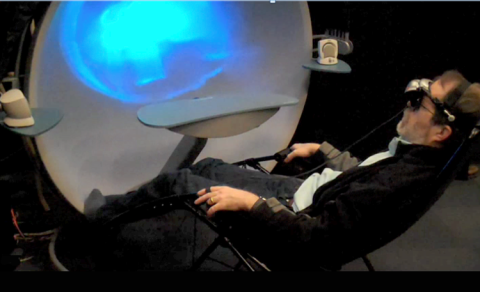
Prof. Diane Gromala, Founding Director of the Transforming Pain Research Group (TPRG) will be exhibiting the evolving work of this team of world-class researchers. Building on an extensive knowledge base from the fields of Pain Medicine, Interactive Art & Design, Computer Science, Neuroscience and Psychophysics, the research group is developing innovative technologies to address chronic pain, a disease that affects 1 in 5 North Americans. Technologies include meditation, biofeedback, immersive Virtual Reality, visualization, robotics and social media.
Diane Gromala is an Associate Professor in the School of Literature, Communication, and Culture, where she teaches in the graduate program in Information Design and Technology at Simon Fraser University. She is an adjunct faculty member in Industrial Design and a faculty member of the transdisciplinary GVU (the Graphics Visualization and Usability Center). Dr. Gromala was one of the first artists to work with immersive virtual reality, beginning with Dancing with the Virtual Dervish. Co-created with Yacov Sharir at the Banff Centre for the Arts' Art & Virtual Environments residency, this piece has been exhibited worldwide from 1993-2004. Subsequent immersive VR work was designed for stress-reduction and pain distraction during chemotherapy. Dr. Gromala's work is currently in use in over 20 hospitals and clinics.
Exhibition Dates: September 29 — October 31, 2011
Art + Sci Gallery
California NanoSystems Institute – UCLA
Room 5419
The Leo/SIGGRAPH issue release reception is from 2-3:30 PM along with the Art Gallery Reception. These will take place at the Art Gallery along with remarks by Leonardo representatives and by the Digital Art Lifetime Award winner.
There will be two Educators Panels held in Theatre 411:
Part 1: 9 A.M.-10:30 A.M
Part 2: 10:45 A.M.-12:15 PM
The Leonardo Town Hall meeting will take place at 3:45 p.m. in Room 506 and continues until 5:45 PM. The last half of the meeting welcomes SIGGRAPH attendees, LEAF and Leonardo members to join in an open, informal discussion to discuss some of the innovative new programs created for transdisciplinary teaching. We invite people to identify the highlights of the SIGGRAPH events they have attended.
Roger Malina will discuss the possibilities for organizing another education panel with SIGGRAPH next year, and we ask that attendees express their preferences for future topics to be explored at upcoming symposia.
Organized by Machiko Kusahara, Art|Sci Visiting Research Scholar and Waseda University, Japan
Sponsored by CREST program of Japan Science and Technology Agency, UCLA Art|Sci Center, and the UCLA Department of Design|Media Arts.
Thu, Feb. 18, Broad Art Center EDA, room 1250
5:30 - 7:00 PM Keynote speaker and lectures, Broad Art Center, EDA, Room 1250
7:00 - 8:00 PM Exhibition Opening Reception, Broad Art Center, 2nd floor patio
Symposium opening with Maywa Denki presentation by Novmichi Tosa
Friday, Feb. 19, 10 am-5 pm C(N)SI Auditorium and Art|Sci gallery
Lectures on Art, Science, and Technology. A special presentation by Novmichi Tosa, followed by afternoon lectures on Device Art, and a panel discussion.
Symposium: Device Art explores new ways of bridging art, design, technology, science and entertainment by using both latest innovations and everyday technology. The two day symposium will include: lectures by academia from Japan and UCLA; performances by artists Novmichi Tosa, Kazuhiko Hachiya, and others; and an exhibition of intriguing gadgets that exemplify Device Art. Exhibitions at EDA Bermant Gallery runs February 18 - February 24, 2010 and the student exhibition in Art|Sci gallery runs through February 18 - March 4, 2010. Hours of exhibition to be announced.
All day parking is available in Lot 3 for the Broad Art Center and Lot 9 for C(N)SI and is $10 per day.
Exhibition at EDA runs Feb. 18-24; Art|Sci gallery Feb 19-March 4