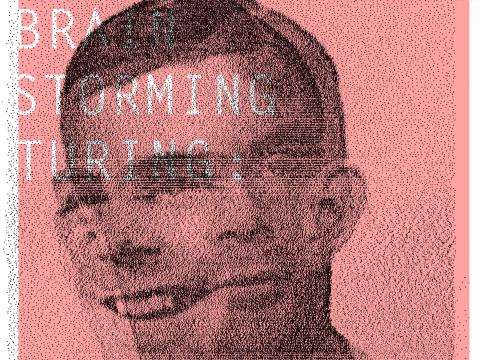
Brainstorming Turing: Celebrating Alan Turing + 25 Years of AI and Society Journal
100 years have passed since Alan Turing was born and we celebrate this historically important individual together with many organizations around the world. We look to show his eccentric creativity in addition to reminding all of the huge contribution he made to computation and artificial intelligence. Short talks by computer / neuro / nano scientists and humanists are accompanied by artists inspired by Turing’s legacy and persona. Additionally, students from UCLA will participate with their ideas of how Turing informs and inspires their work and lives in this time when social networking, robotics and automatic brains are part of daily life.
2012 also marks 25 years since the establishment of AI & Society journal that owes its formation to Turing’s legacy. The Art | Sci center is partnering with this interdisciplinary publication to honor Turing and all those who have contributed over the years. A special issue based on the symposium is planned.
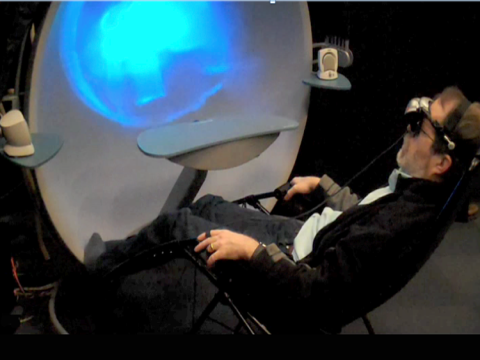
Prof. Diane Gromala, Founding Director of the Transforming Pain Research Group (TPRG) will be exhibiting the evolving work of this team of world-class researchers. Building on an extensive knowledge base from the fields of Pain Medicine, Interactive Art & Design, Computer Science, Neuroscience and Psychophysics, the research group is developing innovative technologies to address chronic pain, a disease that affects 1 in 5 North Americans. Technologies include meditation, biofeedback, immersive Virtual Reality, visualization, robotics and social media.
Diane Gromala is an Associate Professor in the School of Literature, Communication, and Culture, where she teaches in the graduate program in Information Design and Technology at Simon Fraser University. She is an adjunct faculty member in Industrial Design and a faculty member of the transdisciplinary GVU (the Graphics Visualization and Usability Center). Dr. Gromala was one of the first artists to work with immersive virtual reality, beginning with Dancing with the Virtual Dervish. Co-created with Yacov Sharir at the Banff Centre for the Arts' Art & Virtual Environments residency, this piece has been exhibited worldwide from 1993-2004. Subsequent immersive VR work was designed for stress-reduction and pain distraction during chemotherapy. Dr. Gromala's work is currently in use in over 20 hospitals and clinics.
Exhibition Dates: September 29 — October 31, 2011
Art + Sci Gallery
California NanoSystems Institute – UCLA
Room 5419
Chico MacMurtrie was born in New Mexico in 1961. He received his B.F.A. from the University of Arizona and an M.F.A. in New Forms and Concepts from the University of California at Los Angeles. Since 1989, MacMurtrie has exhibited in more than 20 countries worldwide, receiving support from more than 15 national, local, and international granting agencies, and 30 corporate sponsors. His awards include five grants from the National Endowment for the Arts, and his work has been the subject of numerous international broadcasts and texts including the BBC’s Pandemonium, the Discovery Channel’s The Next Step, and Mark Dery’s book Escape Velocity: Cyberculture at the End of the Century.
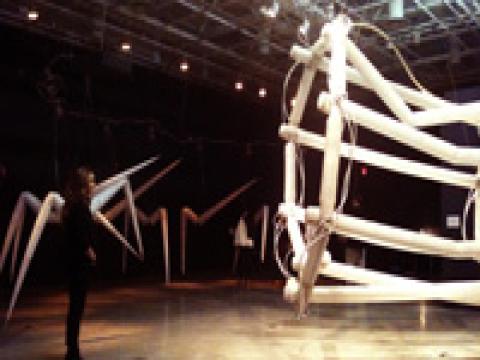
Chico acts as the Artistic Director of Amorphic Robot Works (ARW), a collective he founded in 1991, consisting of artists and engineers who help in the realization of his work. Since that time, his investigations have resulted in the creation of more than 250 mechanical sculptures that assume anthropomorphic and abstract forms. Amorphic Robot Works is a collaborative group of artists, technicians, and programmers who create multi-faceted machine-sculptures that interact in their uniquely designed environments. The work involves a kinesthetic inquiry into the human condition, which has resulted in the creation of more than 250 mechanical sculptures that assume anthropomorphic and abstract forms. Collaborators include Brian Kane whose work on this exhibition marks 20-years of collaboration with ARW; Tymm Twillman who has been developing the sensing and Aurduino based code over the last two years; and Frank Hausman who continues his 20 years of contribution on electronics and Show control.