Artist Kathy High presents the exhibition Waste Matters: You Are My Future, whichexplores immune systems as autopoiesis, capable of maintaining themselves, looking at research in fecal microbial transplants and gut biomes to better understand the important function of bacteria in our bodies. This project looks at the metaphor of interspecies love, immunology and bacteria as players.
KATHY HIGH (USA) is an interdisciplinary artist working in the areas of technology, science, speculative fiction and art. She produces videos and installations posing queer and feminist inquiries into areas of medicine/bio-science, and animal/interspecies collaborations. She hosts bio/ecology+art workshops and is creating an urban nature center in North Troy (NATURE Lab) with media organization The Sanctuary for Independent Media. High is Professor of Video and New Media in the Department of Arts, Rensselaer Polytechnic Institute in Troy, NY. She teaches documentary and experimental digital video production, history and theory, as well as biological arts.
Bio-Artist KATHY HIGH will give a public presentation on her creative work in the emerging field of biological art, a field referred to as "bioart". She will introduce her influences and her interests and amazement with bio-art history.
Kathy High is an internationally recognized, award winning interdisciplinary artist from New York currently working with living systems, animals, and biology and art. She produces videos, sculptures and installations around issues of gender and technology, pursues queer and feminist inquiries into areas of bio-science, science fiction, and animal studies.
Her works have been shown in festivals, galleries and museums nationally and abroad, including the Guggenheim Museum, Museum of Modern Art, Lincoln Center and Exit Art (NYC), the Science Gallery, (Dublin), NGBK, (Berlin), MASS MoCA (North Adams), Videotage Art Space and Para-Site Gallery (Hong Kong), Festival Transitio_MX (Mexico), among others. She has received awards for her works including grants from the John Simon Guggenheim Memorial Foundation (2010), the Rockefeller Foundation, the National Endowment for the Arts and the New York State Council for the Arts.
She has had artist residencies with SymbioticA, art and science residency at the University of Western Australia (2009-20), the Bioart Society of Finland, Helsinki and Kilpisjarvi, Finland (2013) and in Hong Kong with the Asian Arts Council (2005).
Her UCLA exhibition opening April 16 is Waste Matters: You Are My Future and explores immune systems as autopoiesis, capable of maintaining themselves, looking at research in fecal microbial transplants and gut biomes to better understand the important function of bacteria in our bodies. This project looks at the metaphor of interspecies love, immunology and bacteria as players.
Aisen Caro Chacin, Joel Ong and Art|Sci Collective
06 NOVEMBER 2014
CNSI ART|SCI GALLERY
Aisen Caro Chacin, Joel Ong and the Art|Sci Collective joined the multi-year collaboration of Professor Victoria Vesna and evolutionary biologist Dr. Charles Taylor in this sound and art exhibition based on the NSF-sponsored research on Mapping Acoustic Sensor Array of Bird Communication Networks.
Secret Life of Birds built off of this idea and aimed to re-examine the bonds between humans and birds through the perspective of the birds. This ongoing project continues to see various disciplines of art and science converging to present Taylor’s research as a work of art.
An acoustic construction: hyper sound speakers amplify and present sounds from nature.
UCLA Professors Charles Taylor, Evolutionary Biology and Victoria Vesna, Design | Media Arts present the work of Professor Takashi Ikegami and his students Atsushi Masumori, Itzuki Doi, and Norihiro Maruyama. This is one aspect of a multi-year transdisciplinary collaborative project “Mapping the Acoustic Communication Networks of Birds” funded by NSF and will be presented at the upcoming Artificial Life conference in New York.
In this installation the participant/viewer experience sound that can be directed to give a 3D experience and “view” the soundscape from different angles and reflections — similar to the reflections/refraction of light seen through diamonds. Highly directional hyper sound speakers and motion sensors create immersive, targeted soundscape patterns in some ways richer than those which occur naturally. By moving around the viewer can view and review their sound environment with a heightened awareness. We anticipate that Birdsong Diamond will leave viewers with new questions about their soundscape environment.
Opening reception:
April 17, 2014 5-7 pm
Art|Sci Gallery and Presentation Space
CNSI 5th floor
“those that from a distance look like flies”
This exhibition is generously supported by the Swedish Museum of Natural History and the University of California Institute for Research in the Arts. All events sponsored by the David Bermant Foundation.
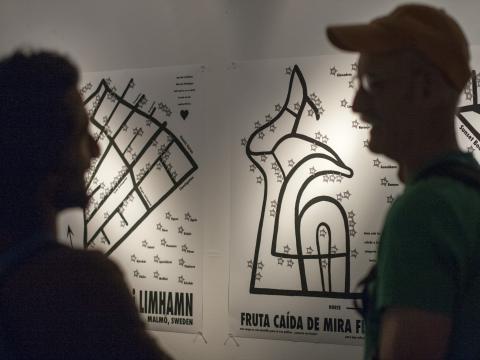
Fallen Fruit presents a set of their Public Fruit Maps paired with their 2010 video, “The Loneliest Fruit in the World.” The maps are one of the collaboration’s signature projects: mapping all the fruit trees that grow in or over public space in neighborhoods around the world to which they are invited. The maps are hand-drawn and distributed free of copyright; they serve as guides for foraging but more importantly as visionary representations of what we hope to see: alternative urban spaces that engender new forms of sharing and thereby create new public experiences. “The Loneliest Fruit in the World” addresses a different kind of public fruit, berries that grow wild in the Arctic. The lingonberry, the salmonberry and the blueberry grow without any human involvement, and for a few short weeks become the site of intense activity as people flock to pick them on all public land. Shot in a residency in Tromsø, Norway, 200 miles above the Arctic Circle, the video follows a group of Norwegians through a beautiful, spare landscape; while picking, they negotiate the relation between solitude, gleaning and company.
ARTIST BIO: Fallen Fruit is a long-term art collaboration that began by mapping fruit trees growing on or over public property in Los Angeles. The collaboration has expanded to include serialized public projects, site-specific installations and happenings in various cities around the world. By always working with fruit as a material or media, the catalogue of projects and works reimagine public interactions with the margins of urban space, systems of community and narrative real-time experience. From participatory performances such as Public Fruit Jams and Fruit Meditations, to ongoing indexical work such as Public Fruit Maps and curated exhibitions that reorganize the social and historical complexities of museums and archives by re-installing their collections through syntactical relationships of fruit as subject, the three artists of Fallen Fruit — David Burns, Matias Viegener, and Austin Young — deploy fruit as a lens through which to see the world.
First interested in pattern formation through his experimental work on Rayleigh-Bénard convection during his PhD, Patrice le Gal was then especially interested in the formation and the interaction of Von Karman wakes and also in the instabilities of the Ekman boundary layer over rotating disks. He has published more than 70 research articles in fluid mechanics: on convective patterns, wakes, turbulence, rotating boundary layer instabilities, plankton bioluminescence and more recently on the elliptic instability. He is currently involved in experiments on stratified and rotating flows: strato-rotational instability, internal wave generation, wave breaking, vortex formation. All of these flows have applications in geo and astrophysics. Recently he developed several art-science projects in collaboration with J. Tejerina-Risso who is a video artist.
Abstract: WAVES is an Art-Science project to install videos, images and multimedia performances based on the visualization of water surface waves. We work at IRPHE (Institut de Recherche sur les Phénomènes Hors Equilibre) in Marseille for designing experiments to produce hydrodynamic waves. We aim to study the behavior of different types of waves and their evolution: generation, breaking, focussing. We present here the general property of waves to focus when properly generated or reflected. Using a parabolicaly shaped wave maker, we focus water waves in a region of the water surface classically called the Huygens Cusp in optics. At this cusp, the amplitude of the waves is increased by focusing and this leads to their breaking which is a typical property of water surface waves. We record these breakings using a fast video camera at a rate of 2000 images per second. A novel and spectacular vision of water wave breakings is obtained when playing these movies at slow speed.
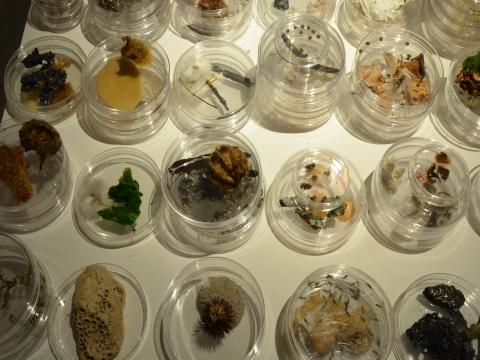
Suzanne Anker is a visual artist and theorist working at the intersection of art and the biological sciences. Her works include digital sculpture, installations and large-scale photography. Her project, Genetic Seed Bank, demonstrates the recuperative and adaptive power of nature and the potential for organic materials as a medium for artistic expression.
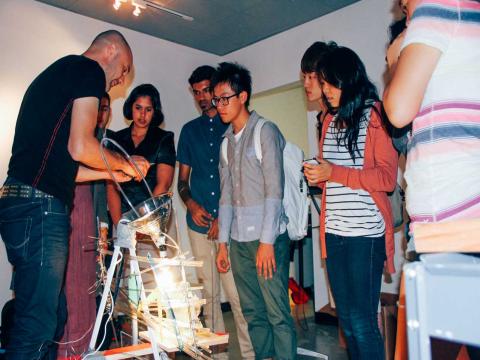
Build-Your-Own Bioreactor was a hands on workshop where participants learned how to build their own green algae bioreactor. They built contraptions that boost algae growth using simple, and mainly recycled and re-used materials such as aeration systems, lights and glassware.
Accompanying the workshop was a lecture on Biomodd, a multifaceted socially engaged art installation that finds meaningful relationships between biology, computers and people. On the most basic level, Biomodd creates symbiotic relationships between plants and computers, and ignites conversations among the community around them. The first version of Biomodd started in Athens, Ohio in 2007, and has since travelled to the Philippines, Slovenia, New Zealand, Belgium and the Netherlands. In each location the project got its own unique outcome. A new version is currently being developed by an international community at the New York Hall of Science in Queens, NY.
Leonardo Art Science Evening Rendezvous (LASER)
Stanford University
Geology Corner (Bldg 320), Room 105
Palo Alto, CA
LASER is a monthly series of lectures and presentations organized by Piero Scaruffi on behalf of Leonardo/ISAST. LASER is sponsored by School of Visual Arts MFA Computer Art Department, Arizona State University Art Museum, Srishti School of Art, Design and Technology, and School of the Art Institute of Chicago Sound Department.
Schedule:
6:45pm-7pm: Socializing/networking.
7pm - 7:25pm: Shona Kitchen (San Jose State Univ's CADRE) on "Speculation of an Alternative Today"
A fresh outlook at technological adaptations and how they can enhance and enrich our surroundings rather that distract us from them.
7:25-7:50pm: Carlo Sequin (U.C. Berkeley) on "Knotty Sculptures"
Simple knots can be used as constructivist building blocks for abstract geometrical sculptures.
7:50-8:05: BREAK
Before or after the break, anyone in the audience currently working within the intersections of art and science will have 30 seconds to share their work. Please present your work as a teaser so that those who are interested can seek you out during social time following the event.
8:05-8:30pm: Margarita Marinova (NASA) on "The Dry Valleys of Antarctica as an Analogue for Mars"
The Dry Valleys of Antarctica are a unique place on Earth: the coldest and driest rocky place, with no plants or animals in sight. Studying the Dry Valleys allows us to understand how the polar regions on Earth work, what the limits of life are - and to apply these ideas to the cold and dry environment of Mars.
8:30pm-8:55pm: Peter Foucault (SFAI) on "Systems and Interactivity in Drawing"
A discussion on how drawings are constructed through mark making systems, and how audience participation can influence the outcome of a final composition, focusing on an interactive robotic drawing installation.