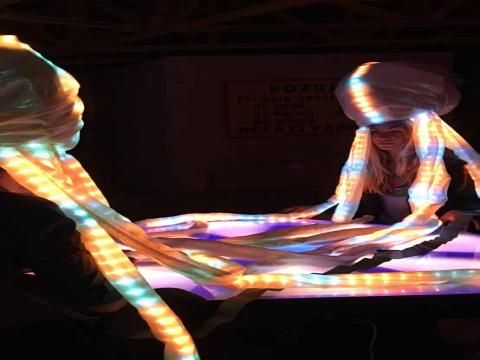
This collective/distributed meditation is an online version of Noise Aquarium, which evolved during the pandemic and was first presented by the Laznia gallery in Gdansk, Poland. We are all interconnected and we all need air to breathe – no matter what our philosophical/ political stance. The invisible virus has turned our world upside down, and we turn our attention to the micro-creatures that give us life. The Noise Aquarium installation is all about achieving inner balance in order to commune with plankton. Now that we cannot be there in person, we try to do the same by connecting online.
Victoria Vesna (New York) and Siddharth Ramakrishnan (Seattle) are joined by Anna Nacher (Slovakia), Rhiannon Catalyst (New York), John Brumley (Birmingham, UK), and Ivana Dama and Clinton van Arman (Los Angeles) who will create a live binaural sonic layering on the animations of plankton by Martina Fröschl.
We invite participation from all across the world to breathe together in rhythm, as we listen and dive into the interconnected ecology of the collective mind and share frequencies of healing amidst all the noise.
Victoria and Siddharth would like to draw your mind to the suffering in South Asia, caused by the lack of medical facilities, primarily the shortage of medical oxygen, in the fight against COVID-19. They have provided a list of organizations you could support to help in the effort to provide oxygen and other life-saving interventions.
Disasters Emergency Committee Coronavirus Appeal
UNICEF India COVID-19 Appeal
[Alien] Star Dust by Victoria Vesna is a site specific immersive art experience that brings alive for the audience the sensation of meteorites and micro-meteorites falling on our planet from many dimensions.
The artist based the work on the museum's collection of meteorites that landed across all continents, as well as on the recorded radio signals reflected from the plasma trails collected from the meteor radar station on the roof of the museum.
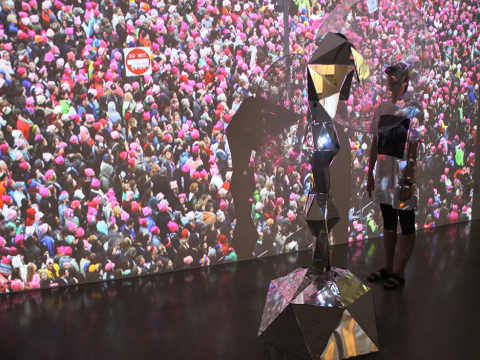
Visitors activate projections of meteorites falling on the existing craters, generating a blend of extra-terrestrial and anthropogenic dust accompanied by the mix of outer space and earthly sounds. Dust knows no boundaries.
"[Alien] Star Dust" is an interactive red carpet exhibit during the Raw Science Film Festival on April 17th, 2020 in Costa Rica.
Raw Science Film Festival live events are postponed until later in 2020. The festival team considers it a challenge to bring science-based technical solutions and communication strategies to ensure a safe event where filmmakers can be honored, live.
Raw Science Film Festival (RSFF) is an annual event that takes place in Los Angeles, California and brings together people across science, technology, entertainment and media to showcase best in class film from around the world. The event was initially made possible through the support of the National Academy of Sciences and The Science and Entertainment Exchange.
The festival was created by Raw Science Inc. founder Keri Kukral thanks to the inspiration of producer Mitchell Block. The mission of RSFF is to humanize science and bring fact-based experts to the forefront of popular culture by celebrating the best science storytelling in the world. The goal is to create a world class film festival for science media on par with Cannes or Sundance Film Festival, and to extend it globally.
RSFF2020 is the 6th annual event and RSFF is collaborating with Gensler and Art|Sci Center and Natural History Museum Vienna are redesign the red carpet, defining a newly accessible and focused Hollywood experience. [Alien] StarDust is the featured, interactive red-carpet exhibit and based on extraterrestrial and anthropogenic dust which falls across the Earth with no boundaries. The art exhibit was developed at the invitation of Dr. Christian Koeberl, geologist and director of Natural History Museum Vienna, home of the one of the largest meteorite collections in the world.
About Loss Less:
In 2008 Kamran Sadeghi was selected resident artist at Satsop. Inspired by Alvin Lucier’s “I am Sitting In A Room” (1970)—Sadeghi amplified an original electronic music passage with a length of 2 minutes into the open aired structure and recorded the outcome of the tower’s acoustic response. This recording was then re-amplified back into the structure and re-recorded. The process was repeated ten times, and with each cycle the natural acoustics of the tower began to reshape the original passage until it disappeared entirely. This approach captured the architectural integrity and holistic immediacy of the nuclear cooling tower while symbolically removing it’s entire existence.
The result is a unique 25 minute sonic experience full of audible artifacts that document space, time and our environment. The composition was created on location and in real-time, allowing all natural elements such as wind, rain, wildlife, resonance and feedback-distortion to be a part in the process and therefore the end result. No post production effects were used.
The ‘Rework’ version is a studio interpretation recorded live using samples of the original composition, processed through effects and used as a guide for added atmospheric electronic tones as counterpoint. The large throbbing bass drum pattern emphasizes the weight and physicality of the cooling tower, while recalling a sacred ceremonial chants or drums used to converse with or drive away destructive spirits.
The title ‘Loss Less’ is a play on the term lossless compression—a type of process that allows for the preservation and and perfect reconstruction of data (audio). In this case the audio was not preserved, but intentionally degraded. The title also taps into the reality of catastrophic loss and destruction caused by nuclear energy, and the call for less.
NanoMandala, by Victoria Vesna in collaboration with nanoscientist James Gimzewski and Tibetan monks from the Ghaden Lhopa Khangsten Monastery - The nano mandala installation incorporates a sand mandala a cosmic diagram and ritualistic symbol of the universe. Visitors watch as images of a grain of sand are projected in evolving scale from the molecular structure of a single grain to the recognizable. Beginning at 5:30pm, Gimzewski will be there in person to introduce this unique collaboration.
UCLA California NanoSystems Institute
(CNSI), 5th floor
JENNIFER MOON explores the possibilities of virtual world-building for ameliorating psychic pain and social anxiety in her 2018 body of work, “Familial Technologies.”
This exhibition is curated from a larger body of work first exhibited at Commonwealth and Council in Los Angeles and includes virtual living spaces and personal avatars developed for use in Avakin Life, a virtual world game that Moon and her parents and brother used to experience family therapy sessions under self-determined circumstances in conjunction with visits to a therapist “IRL”. Moon’s family members are represented here by “player cards” that profile their avatars, screen shots of their individual dwellings in Avakin Life, and screen recordings of their ongoing weekly Avakin Life family relationship sessions.
Through the idealized, mediated virtual platform, the Moon family is able to access aspects of their emotional psyches free of the barriers that physical embodiment presents.
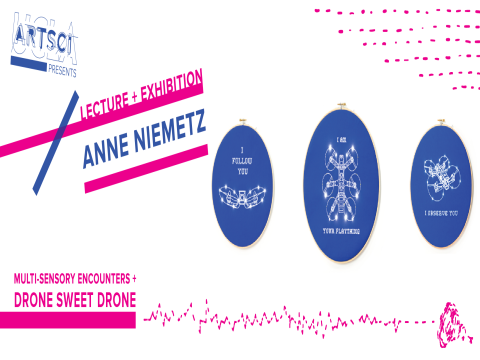
Stealth Drones is comprised of seven embroidery hoops hung in formation. Each hoop contains fractal patterns and ornamentation embroidered in white thread. The hoops are presented on a black velvet backdrop. At regular intervals UV lights are activated in the exhibition space. The embroideries react to the UV light and reveal a new type of information. Once the regular room lights are turned back on, this information disappears.
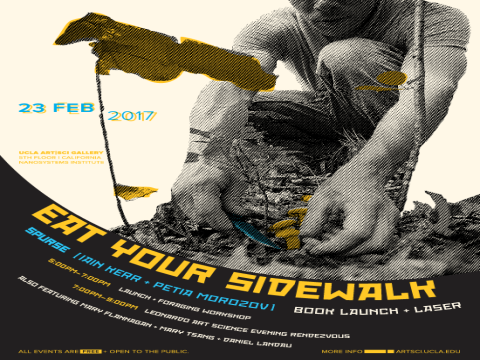
Please join us for our monthly LASER talk following the opening reception for Stealth Drone by Anne_Niemetz.
Friday, 18 October 2019 - 7:00pm to Friday, 1 November 2019 - 9:00pm
Exhibitors / Artists:
Anne Niemetz +
LEONARDO ART SCIENCE EVENING RENDEZVOUS (LASER)
UCLA California NanoSystems Institute | Presentation Space (Fifth Floor)
570 Westwood Plaza, Building 114, 5th floor, Los Angeles, CA 90095
Parking information for Parking Structure 8 https://map.ucla.edu/