Symposium at The California NanoSystems Institute (CNSI)
570 Westwood Plaza, Building 114
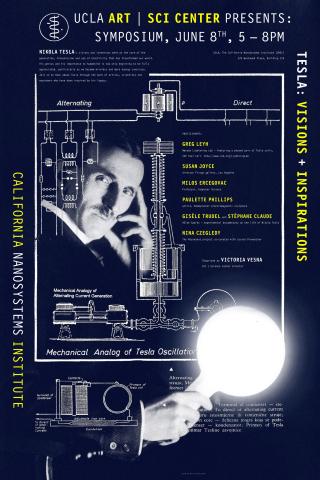
Nikola Tesla’s visions and inventions were at the core of the generation, transmission and use of electricity that has transformed our world. His genius and his importance to humankind is now only beginning to be fully appreciated, particularly as we become wireless and more energy conscious. Join us to hear about Tesla through the work of artists, scientists and engineers who have been inspired by his legacy.
Participants: Greg Leyh - Nevada Lightening Lab – featuring a phased pair of Tesla coils, 122 feet tall. Susan Joyce - director Fringe gallery, Los Angeles Milos Ercegovac - Professor, Computer Science Paulette Phillips - artist, Homewrecker electromagnetic sculpture Gisèle Trudel and Stéphane Claude, AElab Sparks – experimental documentary on the life of Nikola Tesla. Nina Czegledy - The Resonance project co-curated with Louise Provencher. Integratron
Organized and moderated by: Victoria Vesna, media artist, director, Art | Science Center, UCLA
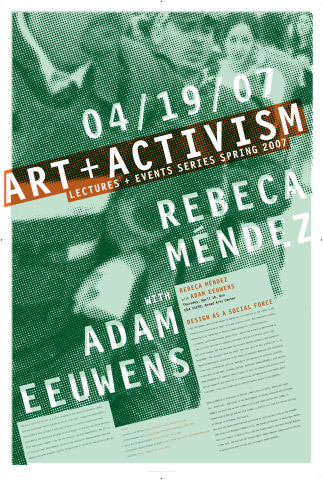
REBECA MENDEZ + ADAM EEUWENS: "Design as a Social Force" Lecture
19 APRIL 2007
EDA, UCLA ART|SCI CENTER
Rebeca Méndez is both a designer and a fine artist. Her work in both arenas has been praised and admired for the past two decades, particularly for its visceral, challenging, and sensual appeal.
Méndez designs primarily for non-profit organizations or cultural institutions. As an artist, she crosses all boundaries, traveling to extreme places such as Iceland, Patagonia, Svalbard, and the Sahara, where she is awakened to a heightened level of perception. She considers the journey as a medium in itself, and “migration” as an essential part of her work.
The profound social ignorance in this country on the topics of immigration, magnified by irresponsible and special interest media platforms that are dominating the conversation, have made her feel unwelcome and thus have heightened the sense of activism in her work and lectures.
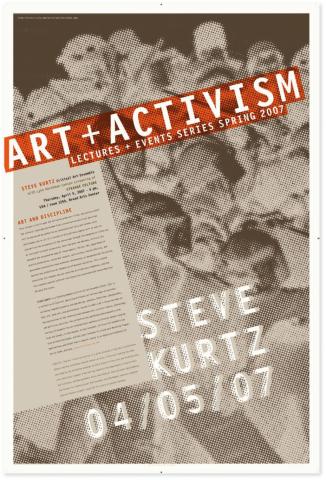
STEVE KURTZ: "Art and Discipline" Lecture
05 APRIL 2007
EDA, UCLA BROAD ART CENTER
This lecture was built upon the following premises: first, any action within the cultural landscape performed from a minoritarian position will be perceived by authority as contestational act; and second, once challenged any or all of a variety of disciplinary agents will be sent to restabilize the discourses of the status quo through the managing or silencing of resistant cultural production.
Steve Kurtz is a founding member of Critical Art Ensemble (CAE). CAE is a collective of tactical media practitioners of various specializations, including computer graphics and web design, wetware, film/video, photography, text art, book art, and performance. Formed in 1987, CAE’s focus has been on the exploration of the intersections between art, critical theory, technology, and political activism. The collective has performed and produced a wide variety of projects for an international audience at diverse venues ranging from the street, to the museum, to the Internet. Critical Art Ensemble has also written five books, and has just released its sixth work Marching Plague: Germ Warfare and Global Public Health. Kurtz is an Associate Professor of Art at SUNY, Buffalo.
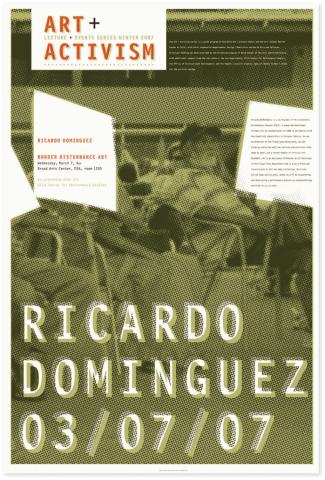
RICARDO DOMINGUEZ: "Border Disturbance Art" Lecture
07 MARCH 2007
EDA, UCLA BROAD ART CENTER
Ricardo Dominguez is co-founder of Electronic Disturbance Theater, a group that developed virtual sit-in technologies in 1998 in solidarity with the Zapatista movement in Chiapas, Mexico. From 2000 to 2004, he was co-director of “The Thing,” an Internet service provider for artists and activists, and is currently a former member of the Critical Art Ensemble. He is an assistant professor in the visual arts department at the University of California, San Diego, and is a principal investigator at the new-edge technology institute Calit2, where he will be researching and developing a performance project on nanotechnology entitled *b.a.n.g lab*.
This lecture was co-presented with the UCLA Center for Performance Studies.
ANURUPA ROY: "Activist Puppetry" Lecture
30 JANUARY 2007
GLORYA KAUFMAN HALL
Anurupa Roy, based in New Delhi, India, believes that puppetry is one of the most powerful tools available for initiating social change. She holds diplomas in puppet theater from the department of puppetry at the Dramatiska Institute in Stockholm, Sweden, and from the Scuola Della Guaratelle in Naples, Italy. In Delhi, she runs Kat-Katha, a puppet troupe that addresses issues such as gender, conflict resolution and AIDS awareness. Her lecture will feature a performance by members of her” Activist Puppetry Against AIDS” World Arts and Cultures course module.
Science can prove that there are billions times a billion of atoms in a grain of sand and show that if we reduced our body to a solid mass of neutrons and protons it would result to a hundredth of a thickness of a human hair. Even there, string theories question this atomistic: view.
When we go beyond the visible realm, we enter into non-materialism and yet the interpretations can still be abstracted from the human condition and remain materialistic. At the same time, this space of “nothingness” is a natural meeting place for art, science, philosophy and spirituality. Join an extraordinary meeting of the minds to ponder how this new age of global communication systems, nano and biotechnology is transforming our perception of reality.
Chuni Lobsang Jinpa Rinpoche
Lama reincarnate, Gaden Shartse Monastic College
Roy Ascott
Theoretician, artist, director, Planetary Collegium, UK
Sigi Hale
Neuroscientist, co-founder Mindful Awareness Research Center, UCLA
Barbara Fields
Director, Association for Global New Thought
James Gimzewski
Nanoscientist, Pico Lab, UCLA
Ven Lama Phuntsho
Translator, Gaden Shartse Monastic College
Organized and moderated by: Victoria Vesna
media artist, director, Art | Science Center, UCLA
The following books will be available for sale at the UCLA Ackerman Book Store:
- Ascott, R. (ed). 2006. Engineering Nature: art & Consciousness in the post-biological era. Bristol: Intellect. ISBN 184150128X
- Roy Ascott Telematic Embrace.Visionary Theories of Art, Technology, and Consciousness
Edited and with an Essay by Edward A. Shanken. Berkeley: University of California Press ISBN 0-520-21803-5
- The Universe in a Single Atom : The Convergence of Science and Spirituality (Hardcover) by Dalai Lama XIV
LINDA WEINTRAUB: "Cycle-Logical Art" Lecture
01 MARCH 2006
EDA, UCLA ART|SCI CENTER
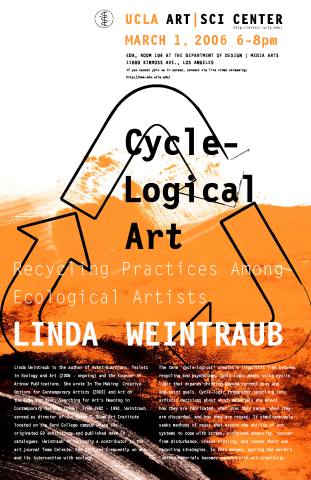
The term 'cycle-logical' creates a linguistic link between recycling and psychology. Cycle-logic means using cyclic logic that expands thinking beyond current uses and end-point goals. It envisions pre-production and post-use scenarios, existing as stations along an ongoing itinerary of material use. Cycle-logic integrates recycling into artistic decisions about which materials are mined, how they are fabricated, what uses they serve, when they are discarded, and how they are reused. It simultaneously seeks methods of reuse that assure the ability of eco systems to cope with stress, withstand adversity, recover from disturbance, create vitality, and invent their own recycling strategies. In this manner, cycling the earth's limited materials becomes equated with art creativity.
Linda Weintraub is the author of Avant-Guardians: Texlets in Ecology and Art (2006 - ongoing) and the founder of Artnow Publications. She wrote In The Making: Creative Options for Contemporary Artists (2003) and Art on the Edge and Over: Searching for Art's Meaning in Contemporary Society (1995). From 1982 - 1993, Weintraub served as the first director of the Edith C. Blum Art Institute located on the Bard College campus where she originated 50 exhibitions and published over 20 catalogues.
She is curator and co-author of Lo and Behold: Visionary Art in the Post-Modern Era, Process and Product: The Making of Eight Contemporary Masterworks, Landmarks: New Site Proposals by Twenty Pioneers of Environmental Art, Art What Thou Eat: Images of Food in American Art, and The Maximal Implications of the Minimal Line. Since leaving Bard College, Weintraub curated a nationally touring exhibition, "IS IT ART?," and she co-curated the internationally touring exhibition, Animal. Anima. Animus.(1999) with Marketta Sepalla. Before her appointment at Bard College, Weintraub was the director of the Philip Johnson Art Gallery at Muhlenberg College. She has taught both contemporary art history and studio art. Weintraub served as Henry R. Luce Professor of Emerging Arts at Oberlin College from 2000-2003. She holds a master of fine arts degree from Rutgers University. Weintraub is currently a contributor to the international art journal Tema Celeste. She lectures frequently on contemporary art and its intersection with ecology.
EDUARDO KAC: "Telepresence and Bio Art" Lecture
24 JANUARY 2006
EDA, UCLA ART|SCI CENTER
Eduardo Kac's work reveals the alternately poetic, political, personal, and philosophical approaches by which the artist examines contemporary life and speculates on our collective future. After an introduction contextualizing his pioneering telepresence work, in progress since the mid-1980s, Kac will give examples and further discuss his current transgenic work. Kac has integrated many disciplines to present an imaginative view of art's relevance to the contemporary world, a view which has firm roots in the artist's background in philosophy and literature. The artist is internationally recognized for his unique artwork which focuses on the relationships among and between humans, animals, machines, and different life forms. The presentation will include a discussion of "GFP Bunny" (Alba, the green rabbit) and "Move 36", Kac's most recent work, shown at Gwangju Biennale, Korea, and Bienal de São Paulo, Brazil.
Following the lecture, the artist will autograph copies of his new book, Telepresence and Bio Art -- Networking Humans, Rabbits and Robots, published by The University of Michigan Press. Eduardo Kac is an artist who exhibited in 2005 at Maison Européenne de la Photographie, Paris; MAXXI - Museo nazionale delle arti del XXI secolo, Rome; and Zendai Museum of Modern Art, Shanghai, among others. In 2005 Kac held a solo show at Galerie Biche de Bere, Paris. He is currently working on a public art commission for the Weisman Art Museum, in Minneapolis, where he will have a solo show in 2006. In March 2006 Kac will have a solo show at Fundación Telefónica, Buenos Aires. Kac is represented at Arco 2006, Madrid, by Black Box Gallery, Copenhagen.
ORLAN: "Free Flow" Lecture
17 JANUARY 2006
EDA, BROAD ART CENTER
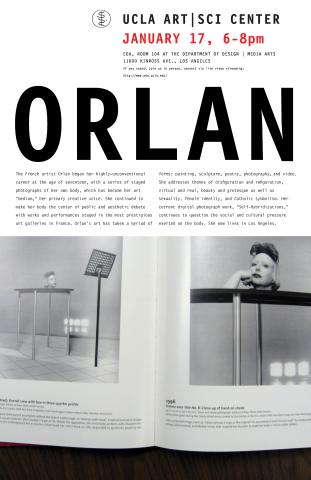
The French Artist Orlan began her highly unconventional career at the age of seventeen, with a series of staged photographs of her own body, which has become her art medium and her primary creative voice. She continued to make her body the center of public and aesthetic debate with works and performances staged in the most prestigious art galleries in France. Orlan’s art has taken a myriad of forms: painting, sculpture, poetry, photography, and video.
She addresses themes of disfiguration and refiguration, virtual and real, beauty and grotesque, as well as sexuality, female identity, and Catholic symbolism. Her current digital photograph work, “Self-Hybridizations” continues to question the social and cultural pressure exerted on the body.
KEN GOLDBERG: "Too Close For Comfort" Lecture
11 JANUARY 2006
EDA, UCLA ART|SCI CENTER
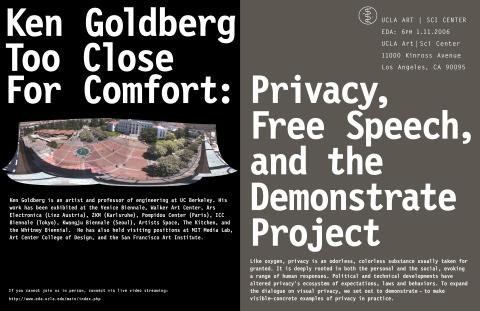
Like oxygen, privacy is an odorless, colorless substance usually taken for granted. It is deeply rooted in both the personal and the social, evoking a range of human responses. Political and technical developments have have altered privacy's ecosystem of expectations, laws and behaviors. To expand the dialogue on visual privacy, we set out to demonstrate - to make visible - concrete examples of privacy in practice.
Commissioned by the Whitney Museum, we installed a state-of-the-art robotic webcamera over UC Berkeley's Sproul Plaza, birthplace of the Free Speech Movement. For six weeks, the camera was made accessible to anyone on the Internet.
Online participants shared remote control of the robot camera, allowing them to zoom in to frame and photograph activity on the Plaza at any time of day or night. During the six-week course of the installation, over 1100 images were taken, putting public activity in Sproul Plaza under scrutiny and placing online participants in the position of hidden observers. The installation provoked a range of reactions. I'll describe what was observed, the controversies, and illustrate with images taken by users.
Ken Goldberg is an artist and professor of engineering at UC Berkeley. His work has been exhibited at the Venice Biennale, Walker Art Center, Ars Electronica (Linz Austria), ZKM (Karlsruhe), Pompidou Center (Paris), ICC Biennale (Tokyo), Kwangju Biennale (Seoul), Artists Space, The Kitchen, and the Whitney Biennial. He has also held visiting positions at MIT Media Lab, Art Center College of Design, and the San Francisco Art Institute. www.ken.goldberg.net


 Participants: