Students from Professor Victoria Vesna’s 2010 graduate seminars Data + Flesh, Department of Design | Media Arts, UCLA + Hybrid Worlds: Nano_Biotech + Art Parsons The New School for Design in New York and UCLA Honors class Biotech + Art exhibit their concepts / proposals / presentations of objects, performances / art installations -- all responding to how we are changing our bodies, the food we consume, the animals we breed & the environment we inhabit.
Parsons seminar co-taught by neuroscientist Siddharth Ramakrishnan
co-sponsored by UCLA Center for Society and Genetics
supported by Leonardo ISAST + UCIRA + Parsons AMT
May 14 - June 7, 2010.Open Monday-Friday, 10 a.m.- 4 p.m.
Parking is $10 all day, and is available near CNSI in structure 9, adjacent to the building. For more information, call 1.310.794.2118.
A symposium on how conceptions of the skeleton have evolved alongside the increasing ability of science to represent the body. Medicine, critical theory, anthropology, and art history will be represented.
Co-sponsored by the Ph.D. Program in Art History
Friday, April 30, 1:00 PM
Rooms 9206 / 9207
No reservations. First come, first seated
Social ArtSci Networked Discourse (SAND) is a new paradigm of teaching as a social network and discourse to address issues that require multi-faceted considerations and point of view. No one can claim authority alone but Professors can design a conceptual platform and engage students who teach what they learn. They become part of an international social network of professional artists and scientists who engage in research that addresses issues raised in class. Language barriers are crossed by having international students who are bi-lingual act as discourse leaders / teachers while bringing back to class different points of view. Time zone and schedule problems are addressed by having local group dialogues recorded and added to the resource.
Double Dutch is a show of the Netherlands based artists Casper Schipper and Antal Ruhl. As both students Design | Media Arts at UCLA and Media Technology at Leiden University, their work uses different media to express topics regarding (mostly) culture and nature, influenced by both science and art.
The show will be one night only, on Thursday April 1st at 5pm. Broad Arts center, EDA gallery.
Guest: Leas Maria
Collaborators: Miu Ling Lam, Romie Littrell, Blanka Buic, Pinar Yoldas
Special thanks to Susan Hopmans and the David Bermant Foundation for their continuous support.
ABOUT
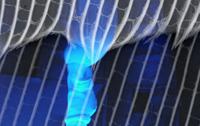
Nanotechnology is changing our perception of life and this is symbolic in the Blue Morpho butterfly with the optics involved -- that beautiful blue color is not pigment at all but patterns and structure which is what nano-photonics is centered on studying. The optics are no doubt fascinating but the real surprise is in the discovery of the way cellular change takes place in a butterfly. Sounds of metamorphosis are not gradual or even that pleasant as we would imagine it. Rather the cellular transformation happens in sudden surges that are broken up with stillness and silence. The audience is invited to immerse themselves in the sounds of metamorphosis and be the performer in the piece.
Organized by Machiko Kusahara, Art|Sci Visiting Research Scholar and Waseda University, Japan
Sponsored by CREST program of Japan Science and Technology Agency, UCLA Art|Sci Center, and the UCLA Department of Design|Media Arts.
Thu, Feb. 18, Broad Art Center EDA, room 1250
5:30 - 7:00 PM Keynote speaker and lectures, Broad Art Center, EDA, Room 1250
7:00 - 8:00 PM Exhibition Opening Reception, Broad Art Center, 2nd floor patio
Symposium opening with Maywa Denki presentation by Novmichi Tosa
Friday, Feb. 19, 10 am-5 pm C(N)SI Auditorium and Art|Sci gallery
Lectures on Art, Science, and Technology. A special presentation by Novmichi Tosa, followed by afternoon lectures on Device Art, and a panel discussion.
Symposium: Device Art explores new ways of bridging art, design, technology, science and entertainment by using both latest innovations and everyday technology. The two day symposium will include: lectures by academia from Japan and UCLA; performances by artists Novmichi Tosa, Kazuhiko Hachiya, and others; and an exhibition of intriguing gadgets that exemplify Device Art. Exhibitions at EDA Bermant Gallery runs February 18 - February 24, 2010 and the student exhibition in Art|Sci gallery runs through February 18 - March 4, 2010. Hours of exhibition to be announced.
All day parking is available in Lot 3 for the Broad Art Center and Lot 9 for C(N)SI and is $10 per day.
Exhibition at EDA runs Feb. 18-24; Art|Sci gallery Feb 19-March 4
Friday 4-8pm: Symposium
Saturday 10am-3pm: Workshop and Exhibition
a symposium exploring new forms of biological and engineering research beyond the university and the corporation and an exhibition and bio-faire for exploring new forms of participation, open science and do it yourself biology.
With:
Gaymon Bennet (SynBERC and Ars-Synthetica.net, Berkley,)
Jason Bobe (DIYBio.org and The Personal Genome Project, Cambridge, MA)
Roger Brent (Fred Hutchison Cancer Center, Seattle)
Phil Lukeman (Cal Poly Pomona)
Hugh Rienhoff (MyDaughtersDNA.org, Berkeley)
Meredith Paterson (Hacker, Belgium)
Victoria Vesna (UCLA Art|Science Center, UCLA Design Media Arts, Los Angeles)
Moderated by:
Christopher Kelty (UCLA Center for Society and Genetics, Los Angeles)
A symposium exploring new forms of public participation in biological research, raising questions and cultivating ideas about how life could and should be studied. Panelists will address issues including do-it-yourself biology, open source science, at home medical genetics, bio-art, and novel ethical engagements with science at the cutting edge. Event schedule includes: Friday, a panelist discussion with artists, scientists and normal people; Saturday, workshops and an open-house exhibition throughout.
Today the life sciences are blooming with possibility. The Human Genome Project is at an end, but the answers it promised remain elusive. Older models of gene action and genetic determinism are crumbling, even as huge pharmaceutical corporations and federally funded university laboratories—Big Bio—continue to drive the research agenda. But just past the frontiers of law and order, a handful of outsiders are trying to remake biology in radical new ways. Synthethetic Biology, DIY Biology, recreational genetics, nanobiotechnology, open source science, patient-driven clinical research, bio-art all in their own ways are challenging Big Bio, and inviting you, the public, to participate.
But can “outlaw biology” really have an effect? What can a band of do-it-yourself biologists teaching themselves to do gel electrophoresis at home really accomplish? Can synthetic and nano-bio engineering cure malaria, as they claim, or just make yogurt glow? Who is “the public” and is it really involved in a meaningful way? What’s good—or bad—about customizing genetic research to explore forgotten diseases
or rare disorders? Can the model that made open source software a success also work in biology? Can artists teach biologists a few things about life, or biologists teach artists something about making? When biology is outlawed, will only outlaws do biology?
Citizen Science | DIY Biology | Nano Hacking | At-Home Clinical Research | Recreational Genetics | Synthetic Biology | Open Source Science | Ars Synthetica | Genetic Art
In the 1980s, poetic and philosophical implications of the serious, scientific search for extraterrestrial intelligence (SETI) helped to inspire pioneering work in a new field of molecular biology art. This presentation will draw together ideas about radio, lasers, genetics, sculpture, mathematics, natural language, history and the nature of discovery itself.
Since October 2005, Lucas has been involved in designing material for the UCLA Art|Sci center and the UCLA Art|Global Health center. This exhibition presents an overview of works by Lucas and his student assistants. Lucas is Professor and Chair of the UCLA Department of Design | Media Arts.
Exhibition opens December 3, 2009 and runs through January 22, 2010.
Location: CNSI Presentation Space & Art | Sci Gallery
UCLA Art|Sci Center + Lab in collaboration with the department of Design Media Arts cordially invite you to attend the quarterly North/South Mixer. Meet and greet with colleagues from across disciplines and geographies.
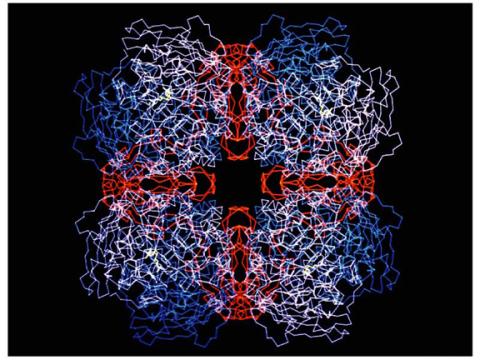
The symposium of cryo-electron microscopy will be very unique in that we are highlighting the latest technology developments that are key to nanomedicine applications. The program is open to students, faculty and industrial researchers in hopes that their expertise and enthusiasm will help develop these possible applications and further the ideas in nano related research.