excerpt from Water Matters: Why We Need to Act Now to Save our Most Critical Resource
The exhibition, the largest to ever appear at the Cathedral, will feature the work of 41 contemporary visual artists, including Mark Rothko, Jenny Holzer, Wiliam Kentridge, Kiki Smith, Bill Viola, Pat Steir, Gregory Amenoff, and others whose work focuses on depicting and reflecting on water.
The 18th century philosopher Novalis wrote, “Our bodies are molded rivers.” Such poetic sentiment is easy to appreciate even in the less-than-poetic age in which we live. We are generally aware of our bodies as organic compositions attuned to the dynamics of nature. It is more difficult, perhaps, to think of buildings as organic bodies in quite the same way. Imagine, for instance, streams of water coursing through the seemingly solid stones of The Cathedral of St. John the Divine in New York; water rising up through the pillars like sap in a soaring forest.
Outside, the Gothic-styled Cathedral seems impressively massive, built to withstand the tempering of time. Inside, the breathtaking view from the Bronze Doors to the far end of the building presents an even more compelling vision: stone, wood and glass, all hard materials of the Earth that have been molded into an architectural body of wondrous dimension. So, where’s the water, that element that makes it a living cathedral rather than just a pile of stones?
The simple answer is that there’s water, water everywhere, as the imagination might fashion it, since none of the stone, wood or glass would exist without the presence and power of water over geological time. As biblical tradition has it, human beings bear the image of their Creator. Perhaps in like manner, all the materials in the Cathedral bear the mark of water, that first element of Creation from which all things were made.
Another simple answer is that water is at the very foundation of the Cathedral. The land on which it stands is dotted with wells, springs, and underground streams. For decades water for the Baptismal Font was drawn from one of them. So, even while we think of the building as the solid monumental body it surely is, we can also envision the water-laced land from which it rises.
Shortly there will be yet another answer to the question, “ Where’s the water in the Cathedral?” “The Value of Water,” an ambitious installation of art opens in September, 2011. Works by painters, sculptors, and media artists, including the seven presented in the following pages, will be installed in bays of the nave, in various chapels, and along the walls of the Great Crossing. As interpreters of the unseen, artists will help us to see what has been there all along; to strengthen our awareness of water, and to prompt our imaginations in the contemplation of water, from wells and underground springs to surging seas and mighty rivers. With this collection of powerful presentations, there really will be water, water everywhere.
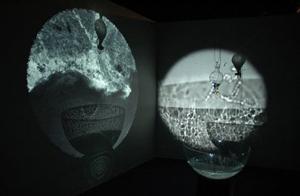
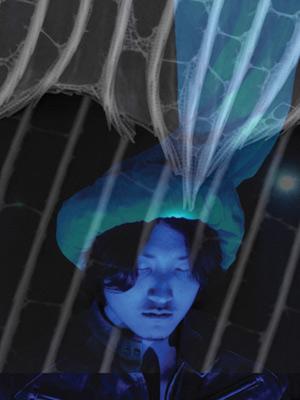
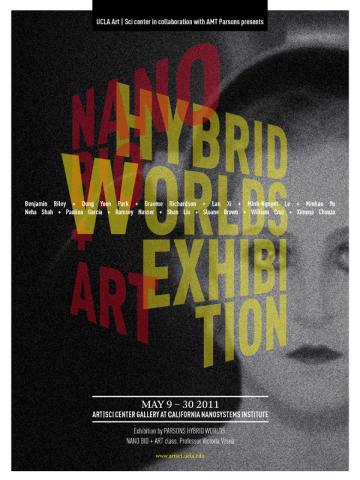
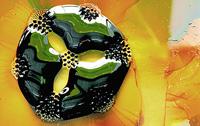
Blue Morph by Victoria Vesna and nanoscientist Jim Gimzewski, is an interactive installation that uses nanoscale images and sounds derived from the metamorphosis of the Blue Morpho butterfly presented in historic St. Cornelius Chapel
Nanotechnology is changing our perception of life and this is symbolic in the Blue Morpho butterfly with the optics involved -- that beautiful blue color is not pigment at all but nano-photonic patterns and structure. The optics are fascinating but the real surprise is in the discovery of the way cellular change takes place in a butterfly. Sounds of metamorphosis are not gradual but rather the cellular transformation happens in sudden surges that are broken up with stillness and silence. Nano is not only making the invisible visible but also changing our way of relating to "silence" or making the in-audible audible. With all the noise of chattering technologies and minds, we propose the interactivity to be stillness for in this empty space of nano we can get in touch with the magic of continuous change. The piece fully emerges in sound and pattern only when the participant is STILL and SILENT.
Credits:
Surround sound: Paul Geluso, Sound processing: Gil Kuno, Interactivity: Paul Geluso, Tyler Adams, Miu Ling, Danaus plexippus chrysalis recording: Andrew Pelling and Paul Wilkinson, Interactive seat construction: Romie Littrell, Knitted morph hat: Silvia Rigon
Installation Designa and Coordination: Aliki Potiris, Interns: Caitlin Morris, Nick Engel, Aliza Simons
Butterfly wing imaging: Marc Castagna, Senior Application Engineer, SEM operator. Thanks to Don Kenia, CEO of FEI Corp. for permission to use the Scanning Electron Microscope.
Morpho peleides and Danaus plexippus wings and pupa provided by Dr. Richard Stringer Department of Math, Science and Allied Health, Harrisburg Area Community College.
More information about the Blue Morph: artsci.ucla.edu/BlueMorph
DIYbio is an organization dedicated to making biology an accessible persuit for citizen scientists, amateur biologists, and biological engineers who value openness and safety. By making tangible tools of science accessible to local Southern California residents, along with sharing knowledge and resources to foster greater experimentation, members inspire discovery and share their passion in the larger community. Led by Sci-artist in residence Romie Littrell.
Chico MacMurtrie was born in New Mexico in 1961. He received his B.F.A. from the University of Arizona and an M.F.A. in New Forms and Concepts from the University of California at Los Angeles. Since 1989, MacMurtrie has exhibited in more than 20 countries worldwide, receiving support from more than 15 national, local, and international granting agencies, and 30 corporate sponsors. His awards include five grants from the National Endowment for the Arts, and his work has been the subject of numerous international broadcasts and texts including the BBC’s Pandemonium, the Discovery Channel’s The Next Step, and Mark Dery’s book Escape Velocity: Cyberculture at the End of the Century.
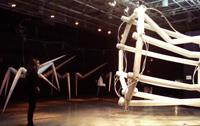
Chico acts as the Artistic Director of Amorphic Robot Works (ARW), a collective he founded in 1991, consisting of artists and engineers who help in the realization of his work. Since that time, his investigations have resulted in the creation of more than 250 mechanical sculptures that assume anthropomorphic and abstract forms. Amorphic Robot Works is a collaborative group of artists, technicians, and programmers who create multi-faceted machine-sculptures that interact in their uniquely designed environments. The work involves a kinesthetic inquiry into the human condition, which has resulted in the creation of more than 250 mechanical sculptures that assume anthropomorphic and abstract forms. Collaborators include Brian Kane whose work on this exhibition marks 20-years of collaboration with ARW; Tymm Twillman who has been developing the sensing and Aurduino based code over the last two years; and Frank Hausman who continues his 20 years of contribution on electronics and Show control.
Working in collaboration with scientists and engineers, science photographer Felice Frankel's images have been published in over 300 journal articles and/or covers and various other publications for general audiences. She will take us through her process of how she creates communicative representations of scientific research and discuss the hurdles and ethical questions confronted by all those representing scientific data and concepts.
Colleen Macklin focuses on creating new games, simulaltions and playing experiences which encourages experimental learning and investigation into social and global issues. She is the director of PETlab (prototyping, evaluation, teaching and learning lab) and has led social media learning projects with partners such as the UN and Open Society Institute. She will be exploring the development of science games while in residence at the Art Sci Center. Associate Professor, Parsons the New School for Design.
"The Lifeification of Games: some thoughts about science, games and saving the world"
4:00PM Talk, CNSI Auditorium
5:00PM Reception and Games, CNSI Presentation Space.
Location: CNSI Building 570 Westwood Plaza, Los Angeles
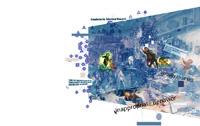
Ellen Levy's installation, Norms of Behavior, addresses the cultural issues involved in adjudicating health and illness and in confronting the limits of our perception. She integrates these concerns in Cultural Epidemiology an annotated and transfigured reworking of Jan Steen's The Village School, and Stealing Attention which reflects on Carravagio's The Cardsharps.
Context Providers: Conditions of Meaning in Media Arts Book Launch Party
North | South social mixers are quarterly gatherings of faculty, staff and students from north and south campus for networking and interaction. Come meet and greet colleagues from the other side of campus!