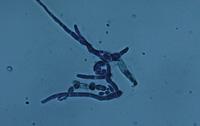
work based On Darwin's Tracings of plants movements on glass
By Julie Pate
Julie's technique uses nail polish to add a shimmering quality to the patterns and floral designs found throughout nature.
All spaces today are blurring from museums to stores, from the private to the public. I am interested in framing Museum's gallery spaces, and creating (presents) for the viewer (to BE in).
Julie's technique uses nail polish to add a shimmering quality to the patterns and floral designs found throughout nature.
Franceschini is an artist and educator. She founded Futurefarmers in 1995 to bring together multidisciplinary practitioners to create new work. She is currently teaching media theory and practice courses at Stanford University and the San Francisco Art Institute.
Brad Hansen is an Associate Professor in Physics & Astronomy at UCLA since 2001, with prior positions at the University of Toronto and Princeton University PHD from California Institute of Technology in 1996. Hansen is a native of South Africa. Has, on separate occasions, been charged by both a moose and a rhinoceros, and consequently is convinced that the animal kingdom has a secret vendetta against him.
"I am interested in the death of stars and the birth of planets. In this talk, I will describe why we think black holes exist, what they are, and how they affect their environment."
The Art | Sci center is hosting an open salon series for students, faculty, alumni, and all members of the academic community across disciplines every other Friday. This brown-bag lunch series is part of the center's mission to promote cross-pollination between the arts and sciences and to engage as diverse an audience as possible. Previous experience between art and science is not required. LUNCH WILL BE PROVIDED! Please email water@arts.ucla.edu to sign up.
Ramesh Jain, UC Irvine, Professor in Bren School of Information and Computer Sciences
Ramesh joined University of California, Irvine as the first Bren Professor in Bren School of Information and Computer Sciences in 2005. Ramesh has been an active researcher in multimedia information systems, image databases, machine vision, and intelligent systems. While professor of computer science and engineering at the University of Michigan, Ann Arbor and the University of California, San Diego, he founded and directed artificial intelligence and visual computing labs. He has co-authored more than 250 research papers in well-respected journals and conference proceedings. Among his co-authored and co-edited books include Machine Vision, a textbook used at several universities. His current research is in experiential computing and its applications.
Dyana Valentine is an instigator-consultant who designed a process to help self-starters self-finish. She has a Master's degree from Antioch University and divides her time between grooming the next generation of community psychologists and schooling clients on how to move projects forward with grace and style. Her passion is helping people make and maintain the connections they need to grow themselves and their businesses, which she does via private consulting for individuals and institutions, as well as through her energetic private workshops.
Working alone or being in charge is a double-edged sword. Yes, you're in control, but you may find it hard to exercise that control without support or resources. In this workshop, led by professional development and project coach Dyana Valentine, you'll meet other designers committed to doing what they do better, and also learn how to maintain connections that will help you match struggles with strengths—and achieve your goals for growing your business.
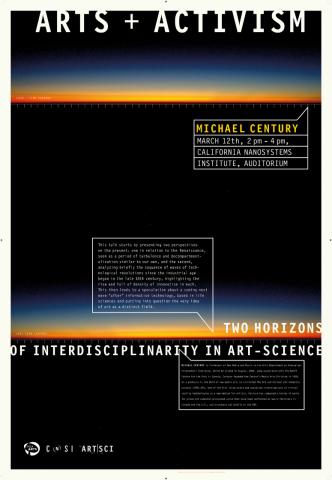
MICHAEL CENTURY: "Twin Horizons of Interdisciplinary in Art-Science" Lecture
12 MARCH 2009
EDA, UCLA BROAD ART CENTER
Michael Century is Professor of New media and Music in the Arts Department at Rensselaer Polytechnic Institute, which he joined in August, 2002. Long associated with The Banff Centre for the Arts in Canada, Century founded the Centre’s Media Arts Division in 1988. As a producer in the field of new media art, he initiated The Art and Virtual Environments project (1991-94), one of the first large-scale and sustained investigations of virtual reality technologies as a new medium for artists.
His talk presented two perspectives on the present: one in relation to the Renaissance, seen as a period of turbulence and decompartmentalization similar to our own, and the second, analyzing briefly the sequence of waves of technological revolutions since the industrial age began in the late 18th century, highlighting the rise and fall of density of innovation in each. This led to a discussion about a coming next wave “after” information technology, based in life sciences and putting into question the very idea of art as a distinct field.
The UCLA Art | Sci Center + Lab and the University of California Digital Arts Research Network (UCDARnet) proudly announces the Sound + Science Symposium - a trans-disciplinary exploration of scientific research and technological breakthroughs concerned with sound, hearing, and aurality. This two-day event will bring together leading figures to discuss the applications and implications of such research in relation to questions of culture, politics, history, environment, art, and music.
The symposium will take place on March 5th and March 6th from 10am-7pm at the California NanoSystems Institute Auditorium at UCLA. The symposium is free and open to the public - parking at UCLA is $9 per day.
Sound + Science is a satellite event of Scalable Relations - a series of networked exhibitions that present media artworks by faculty of the UC Digital Arts Research Network (DARnet) across UC campuses from January 9 - March 14, 2009
The Art + Activism in the 21st Century Series, in conjunction with the UCLA Chicano Studies Research Center, is pleased to celebrate the publication of Yolanda M. López, Volume 2 in the UCLA CSRC’s A Ver: Revisioning Art History book series, on Wednesday, March 4, 3:00–5:00 p.m., in the CSRC Library-Haines 144.
The artist, Yolanda M. Lopez, and the author, Karen-Mary Davalos, Loyola Marymount University, will discuss Ms. Lopez’s life and work and her contributions to Chicano and American art. The program will be introduced by Charlene Villaseñor Black, UCLA Department of Art History.
*A reception and signing will follow, and books will be available for purchase.*
The Art + Activism series is a joint program of the Art | Sci Center, Art | Global Health Center, Center for Performance Studies, Chicano Studies Research Center, Department of Design | Media Arts, Department of World Arts and Cultures, and Theater, Film and Television. Principal funding is provided by the ArtsForum program of the UCLA School of the Arts and Architecture. Other sponsors of this event include the UCLA Office of Faculty Diversity and Development, Center for the Study of Women, César E. Chávez Department of Chicana/o Studies, and Department of Art History.
Opening Reception: Fri, February 27th, 5-7pm
Exhibit Dates: February 27 - March 20
CN(S)I Art|Sci Lab, Suite 5419, Parking Lot 9
Invisible Earthlings is an investigation into the possibilities of relating between humans and members of the lived non-human worlds that we are least likely to recognize as social actors within urban environments: microbes. Microbes, partially defined by their small size and the fact that they are commonly not visible to the human eye, quite literally escape our view and thereby our awareness of their existence. Although most people have some vague notion about the importance of microbes in our ecosystems, microbes commonly only receive our attention when they are perceived to cause problems-"problems" in this case defined as either harmful to human, plant, and animal health, or our material goods. But what type of activities are the numerous relatives of these so-called "harmful microbes" performing while we are walking by, stepping right on top of them, or busily shopping for "mold resistant" building materials? What types of organisms are present, what types were present once but are no longer, and why? Where did they come from, what do we know about them, what type of roles have and are they performing in different historical and geographical settings?
Beatriz da Costa is an interdisciplinary artist and researcher who works at the intersection of contemporary art, science, engineering and politics. Her work takes the form of public participatory interventions, locative media, conceptual tool building and critical writing. da Costa has also made frequent use of wetware in her projects and has recently become interested in the potential of interspecies co-production in the pursuit of resistant practices. da Costa is a former collaborator of Critical Art Ensemble and co-founder of Preemptive Media, an art, activism and technology group. Her work has been exhibited nationally and internationally, including the Andy Warhol Museum, the Zentrum für Kunst und Medien in Germany, and the Natural History Museum in London. Recent media coverage includes the New York Times, the Los Angeles Times, Reuters and the New Scientist. da Costa is Associate Professor in the Arts, Computation, Engineering graduate program at the University of California, Irvine.
Location: UCLA California NanoSystems Institute Auditorium
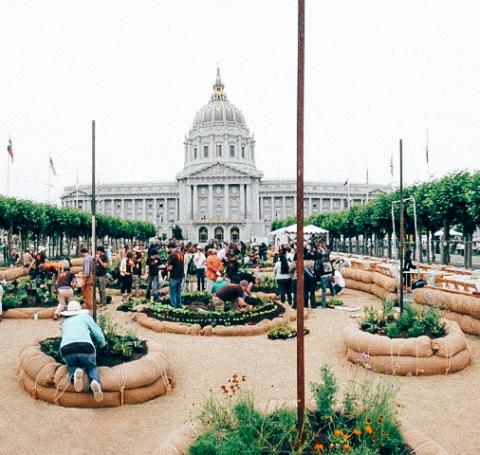
Co-founded in 2003 by the international non-profit Slow Food and the Italian regions of Piedmont and Emilia-Romagna, the school’s innovative approach is to create a new understanding of gastronomy, linking the act of eating with the act of producing, along with all the phases in between. Four programs at two Italian campuses follow a multidisciplinary learning model, merging science with humanities, sensory training with communications, classroom study with field seminars. The Slow Food movement was founded by Carlo Petrini in Italy to combat fast food. It claims to preserve the cultural cuisine and the associated food plants and seeds, domestic animals, and farming within an ecoregion. It was the first established part of the broader Slow movement. The movement has since expanded globally to over 83,000 members in 122 countries.



 The artist, Yolanda M. Lopez, and the author, Karen-Mary Davalos, Loyola Marymount University, will discuss Ms. Lopez’s life and work and her contributions to Chicano and American art. The program will be introduced by Charlene Villaseñor Black, UCLA Department of Art History.