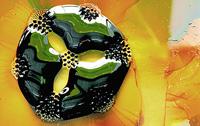
Opening Reception Thursday October 27, 5pm-7pm, gallery@calit2
Panel Discussion Friday October 28, 12pm-2pm, Calit2 Auditorium
Harold Cohen, founding director of the Center for Research in Computing and the Arts (CRCA), was an English painter with an established international reputation when he came to UCSD in 1968 for a one-year Visiting Professorship. His first experience with computing followed almost immediately, and he never returned to London. Cohen is the author of the celebrated AARON program, an ongoing research effort in autonomous machine (art making) intelligence, which began when he was a visiting scholar at Stanford University's Artificial Intelligence Lab in the early 1970s. Together, Cohen and AARON have exhibited at London's Tate Gallery, the LA County Museum, the Brooklyn Museum, the San Francisco Museum of Modern Art, Amsterdam's Stedelijk Museum, the Museum of Contemporary Art San Diego and many more of the world's major art spaces. They have al! so been shown at a dozen science centers, including the Ontario Science Center, the Boston Science Museum and the Los Angeles Museum of Science and Industry. Cohen represented the U.S. in the world’s fair in Tsukuba, Japan, in 1985. He has permanent exhibits devoted to his work in the Museum of Computing History in Mountain View, CA, and in the Carnegie Science Center in Pittsburgh.
An acknowledged pioneer in relation to computing in the arts, Cohen has given invited papers on his work at major international conferences on AI, computer graphics and art technologies, and his work is widely cited in the literature.
More than forty years of continuous work on and with AARON has significantly transformed the typical artist/medium—or programmer/program—relationship for Cohen. One of the few artists ever to have become deeply involved in artificial intelligence, he began with a strong thrust towards program autonomy, in the course of which AARON became the only program in existence to function as a world-class colorist. Today, however, he regards AARON as collaborator rather than independent artist. The changing states of this relationship are reflected in the three groups of works in this exhibition: works on paper made by AARON and presented as "orthodox" editioned prints: one-off printed images that have then been permanently mounted and surface-treated to function as "paintings." In the most recent work, AARON generates "underpaintings" ra! ther than completed images, printing them on canvas for Cohen to develop by hand. The exhibition also includes a screen-based version of the program in the exhibition, which continuously modifies a single image for the duration of the show.
Prof. Diane Gromala, Founding Director of the Transforming Pain Research Group (TPRG) will be exhibiting the evolving work of this team of world-class researchers. Building on an extensive knowledge base from the fields of Pain Medicine, Interactive Art & Design, Computer Science, Neuroscience and Psychophysics, the research group is developing innovative technologies to address chronic pain, a disease that affects 1 in 5 North Americans. Technologies include meditation, biofeedback, immersive Virtual Reality, visualization, robotics and social media.
Diane Gromala is an Associate Professor in the School of Literature, Communication, and Culture, where she teaches in the graduate program in Information Design and Technology at Simon Fraser University. She is an adjunct faculty member in Industrial Design and a faculty member of the transdisciplinary GVU (the Graphics Visualization and Usability Center). Dr. Gromala was one of the first artists to work with immersive virtual reality, beginning with Dancing with the Virtual Dervish. Co-created with Yacov Sharir at the Banff Centre for the Arts' Art & Virtual Environments residency, this piece has been exhibited worldwide from 1993-2004. Subsequent immersive VR work was designed for stress-reduction and pain distraction during chemotherapy. Dr. Gromala's work is currently in use in over 20 hospitals and clinics.
Exhibition Dates: September 29 — October 31, 2011
Art + Sci Gallery
California NanoSystems Institute – UCLA
Room 5419
excerpt from Water Matters: Why We Need to Act Now to Save our Most Critical Resource
The exhibition, the largest to ever appear at the Cathedral, will feature the work of 41 contemporary visual artists, including Mark Rothko, Jenny Holzer, Wiliam Kentridge, Kiki Smith, Bill Viola, Pat Steir, Gregory Amenoff, and others whose work focuses on depicting and reflecting on water.
The 18th century philosopher Novalis wrote, “Our bodies are molded rivers.” Such poetic sentiment is easy to appreciate even in the less-than-poetic age in which we live. We are generally aware of our bodies as organic compositions attuned to the dynamics of nature. It is more difficult, perhaps, to think of buildings as organic bodies in quite the same way. Imagine, for instance, streams of water coursing through the seemingly solid stones of The Cathedral of St. John the Divine in New York; water rising up through the pillars like sap in a soaring forest.
Outside, the Gothic-styled Cathedral seems impressively massive, built to withstand the tempering of time. Inside, the breathtaking view from the Bronze Doors to the far end of the building presents an even more compelling vision: stone, wood and glass, all hard materials of the Earth that have been molded into an architectural body of wondrous dimension. So, where’s the water, that element that makes it a living cathedral rather than just a pile of stones?
The simple answer is that there’s water, water everywhere, as the imagination might fashion it, since none of the stone, wood or glass would exist without the presence and power of water over geological time. As biblical tradition has it, human beings bear the image of their Creator. Perhaps in like manner, all the materials in the Cathedral bear the mark of water, that first element of Creation from which all things were made.
Another simple answer is that water is at the very foundation of the Cathedral. The land on which it stands is dotted with wells, springs, and underground streams. For decades water for the Baptismal Font was drawn from one of them. So, even while we think of the building as the solid monumental body it surely is, we can also envision the water-laced land from which it rises.
Shortly there will be yet another answer to the question, “ Where’s the water in the Cathedral?” “The Value of Water,” an ambitious installation of art opens in September, 2011. Works by painters, sculptors, and media artists, including the seven presented in the following pages, will be installed in bays of the nave, in various chapels, and along the walls of the Great Crossing. As interpreters of the unseen, artists will help us to see what has been there all along; to strengthen our awareness of water, and to prompt our imaginations in the contemplation of water, from wells and underground springs to surging seas and mighty rivers. With this collection of powerful presentations, there really will be water, water everywhere.
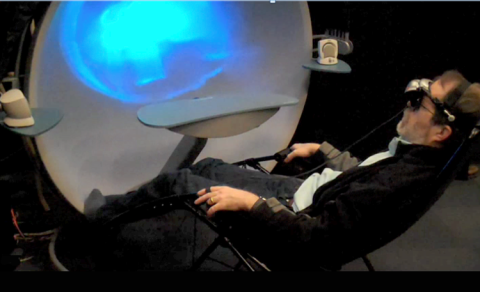
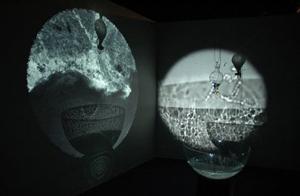
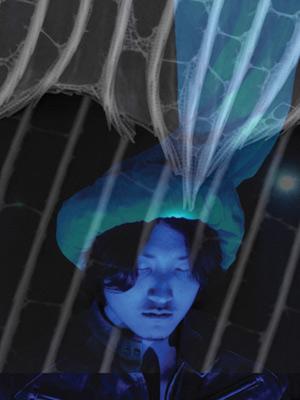
Blue Morph by Victoria Vesna and nanoscientist Jim Gimzewski, is an interactive installation that uses nanoscale images and sounds derived from the metamorphosis of the Blue Morpho butterfly presented in historic St. Cornelius Chapel
Nanotechnology is changing our perception of life and this is symbolic in the Blue Morpho butterfly with the optics involved -- that beautiful blue color is not pigment at all but nano-photonic patterns and structure. The optics are fascinating but the real surprise is in the discovery of the way cellular change takes place in a butterfly. Sounds of metamorphosis are not gradual but rather the cellular transformation happens in sudden surges that are broken up with stillness and silence. Nano is not only making the invisible visible but also changing our way of relating to "silence" or making the in-audible audible. With all the noise of chattering technologies and minds, we propose the interactivity to be stillness for in this empty space of nano we can get in touch with the magic of continuous change. The piece fully emerges in sound and pattern only when the participant is STILL and SILENT.
Credits:
Surround sound: Paul Geluso, Sound processing: Gil Kuno, Interactivity: Paul Geluso, Tyler Adams, Miu Ling, Danaus plexippus chrysalis recording: Andrew Pelling and Paul Wilkinson, Interactive seat construction: Romie Littrell, Knitted morph hat: Silvia Rigon
Installation Designa and Coordination: Aliki Potiris, Interns: Caitlin Morris, Nick Engel, Aliza Simons
Butterfly wing imaging: Marc Castagna, Senior Application Engineer, SEM operator. Thanks to Don Kenia, CEO of FEI Corp. for permission to use the Scanning Electron Microscope.
Morpho peleides and Danaus plexippus wings and pupa provided by Dr. Richard Stringer Department of Math, Science and Allied Health, Harrisburg Area Community College.
More information about the Blue Morph: artsci.ucla.edu/BlueMorph
Working in collaboration with scientists and engineers, science photographer Felice Frankel's images have been published in over 300 journal articles and/or covers and various other publications for general audiences. She will take us through her process of how she creates communicative representations of scientific research and discuss the hurdles and ethical questions confronted by all those representing scientific data and concepts.
Exhibition “Genesis” by artist in residence in the department of Design | Media Arts. Fulbright scholar, Ukraine.
Artist Lecture at 2:00pm in Fowler Museum, A103B Exhibition Opening at 6:00pm in EDA, Broad Arts Center
Location: EDA, Broad Art center.
Oksana Chepelyk, a Design | Media Arts Fulbright visiting artist, presents Genesis, a multi-part video and photography installation that examines the genetic currency of the nation. A real-time data stream monitoring newborn births creates an infant data base, triggering visual changes on projected images of children around the world. Each act of childbirth adds up to the collective image of a newborn baby.
Studio Stefania Miscetti wishes you a BUON DOMANI \ A BETTER TOMORROW by celebrating its twentieth anniversary through a major group exhibition, bringing together the desires, wishes and projects of the artists who were involved in the gallery’s path and others, some young and some not, to who we look to for the future.
Art goes beyond the limits within which time would like to constrict her, and indicates the contents of the future. (Wassily Kandinsky)
Studio Stefania Miscetti through the years has been inviting artists to exhibit active and purposeful projects, defending the deep conviction that the role of art is to indicate and suggest ways that favour an analysis and understanding of the worlds we live in.
Today more than ever, we believe that we have to adjust to desires and perspectives that give us a license for the future. A future constantly mentioned and spoken about, but its concrete idea often left to fade away, with us waiting and waiting for more favourable conditions. It is important and necessary that this process returns to be rooted in the present, being directed to address and seek to improve the' here and now ', projecting it into the future.
Moving away from any rhetoric, A BETTER TOMORROW means continuing to have a positive vision that calls for a possible and near future. The exhibition is a metaphor for a better tomorrow; it is the wish to share at the end of this year.
The works are offered as individual messages in the form of cards, collages, photographs and other creations, all of small size. Light fragments, small auguring and auspicious spirits, which moving from the top of the space trace relations, a dialogue between distant generations united together in the need to surprise, to extend and broaden the world's issues so not to give up our vital transformation. Dialogue has been our aspiration for twenty years, convinced as we are not to resign ourselves to the actual pervasive vacuum of visions and plans.
In an age when digital and biological life forms are melting into each other, what is happening to art? What is to be found in this fluid zone between bytes and atoms? Biotopia has come up with some works of art, which, in addition to their aesthetic qualities, set out to answer the question, “What happens when technology and human beings challenge one another?” Is the artist a new kind of scientist? Or is it the other way round? Biotopia will be a forum, where the unstable relations between mankind, art and technology are exhibited and expressed in a variety of scenarios, which members of the public can examine and explore.