Opening Reception: Fri, February 27th, 5-7pm
Exhibit Dates: February 27 - March 20
CN(S)I Art|Sci Lab, Suite 5419, Parking Lot 9
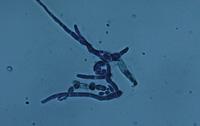
Invisible Earthlings is an investigation into the possibilities of relating between humans and members of the lived non-human worlds that we are least likely to recognize as social actors within urban environments: microbes. Microbes, partially defined by their small size and the fact that they are commonly not visible to the human eye, quite literally escape our view and thereby our awareness of their existence. Although most people have some vague notion about the importance of microbes in our ecosystems, microbes commonly only receive our attention when they are perceived to cause problems-"problems" in this case defined as either harmful to human, plant, and animal health, or our material goods. But what type of activities are the numerous relatives of these so-called "harmful microbes" performing while we are walking by, stepping right on top of them, or busily shopping for "mold resistant" building materials? What types of organisms are present, what types were present once but are no longer, and why? Where did they come from, what do we know about them, what type of roles have and are they performing in different historical and geographical settings?
Beatriz da Costa is an interdisciplinary artist and researcher who works at the intersection of contemporary art, science, engineering and politics. Her work takes the form of public participatory interventions, locative media, conceptual tool building and critical writing. da Costa has also made frequent use of wetware in her projects and has recently become interested in the potential of interspecies co-production in the pursuit of resistant practices. da Costa is a former collaborator of Critical Art Ensemble and co-founder of Preemptive Media, an art, activism and technology group. Her work has been exhibited nationally and internationally, including the Andy Warhol Museum, the Zentrum für Kunst und Medien in Germany, and the Natural History Museum in London. Recent media coverage includes the New York Times, the Los Angeles Times, Reuters and the New Scientist. da Costa is Associate Professor in the Arts, Computation, Engineering graduate program at the University of California, Irvine.
Opening Reception: Thu, January 29, 5-7pm
Exhibit Dates: January 29 - February 20
UCLA CN(S)I, ART | SCI Lab, Suite 5419
Public Secrets
There are secrets that are kept from the public and there are "public secrets," secrets that the public chooses to keep from itself-"don't ask, don't tell." The trick to the public secret is in knowing what not to know. This is the most powerful form of social knowledge. Such shared secrets sustain social and political institutions. The injustices of the war on drugs, the criminal justice system, and the Prison Industrial Complex are public secrets. Public Secrets provides an interactive interface to an audio archive of hundreds of statements made by current and former prisoners, which unmask the secret injustices of the war on drugs, the criminal justice system, and the prison industrial complex. Visitors navigate a multi-vocal narrative that links individual testimony and public evidence, social theory, and personal statements, in an effort to engage the public in a critical dialogue about crime and punishment.
Interactive, database-driven website with audio navigated with Wii controller
Blood Sugar is a "new media documentary" that examines the social and political construction of poverty, alienation, and addiction in American society through the eyes of those who live it. Blood Sugar provides an interactive interface to an audio archive of conversations with 24 current and former injection drug users recorded at the HIV Education and Prevention Program of Alameda County and in California state prisons. Since addicts must fear encounters with regimes of enforcement, they are afraid to be seen-but they do want to be heard. Theirs are the most important voices in the discourse around addiction, public health, poverty and belonging in America. Through the stories of those most affected by addiction, Blood Sugar challenges us to address question such as, what is the social and political status of the addicted? Is the addict considered fully human, diseased, possessed or wholly "other" and thus rendered ideologically appropriate to her status as less than human?
Sharon Daniel is an artist whose research involves the use and development of information and communications technologies for social inclusion. Daniel engages in the production of “new media documentaries”-building online archives and interfaces that make the stories of technologically disenfranchised communities available across social, cultural, and economic boundaries. Daniel's work has been exhibited internationally at museums and festivals including Transmediale 08, the ISEA/ZeroOne festival, the Dutch Electronic Arts Festival, Ars Electronica, the Lincoln Center Festival, the Corcoran Biennial and the University of Paris I, as well as on the Internet. Her essays have been published in books and professional journals, such as Database Aesthetics (Minnesota University Press, 2007), the Sarai Reader, and Leonardo. Daniel is a Professor of Film and Digital Media and Chair of the Digital Arts and New Media MFA program at the University of California, Santa Cruz, where she teaches classes in digital media theory and practice.
January 9 – March 14, 2009
Opening Reception: January 8, 6:30 – 9:00 pm
Family Day: February 21, 11:00 am – 3:00 pm
Boxed: March 12, 6:30 – 9:00 pm
The exhibition brings together works that explore digital media's capability of representing a growing amount of data in constantly evolving relations. Addressing a range of issues—from the construction of visual worlds to self-representation and socio-cultural and political issues—the projects in Scalable Relations illustrate the complexities and shifting contexts of today's information society.
Location: The gallery is located near the intersection of West Peltason and Pereira Drive at the Claire Trevor School of the Arts at UC Irvine.
Beall Center for Art + Technology
712 Arts Plaza
Claire Trevor School of the Arts
Univeristy of Claifornia
Irvine, CA 92697-2775 www.beallcenter.uci.edu
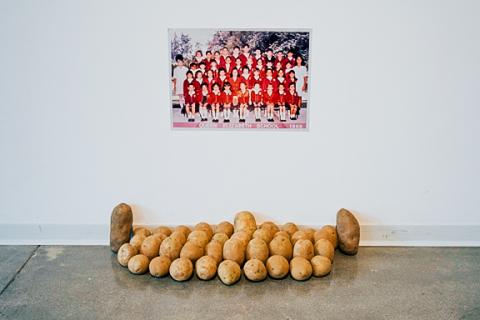
My installation "Gestation" explores the tensions that are implicit in social contracts between individuals and institutions, and how these 'agreements' form our identity.
Only a fine line separates nurture and control. I see the potato as a metaphor for the human being for several reasons: one, the potato is the lowest common denominator of vegetables; two, as a basic staple food, its consumption transcends social boundaries; three, the potato holds energy within, enough to power a radio; and four, its form resembles that of an organ.
When I wrap the potato in latex, I ward off the germs, as would a surgeon when exposing the interior of a human body. I hold the object as I sew the protective pouch and I feel like I'm nurturing it, but at the same time I'm confining the object within this simulation of skin. When the potato hangs suspended from the thread, and with the passing of time, disturbances in the clinical begin to germinate. As the latex either melts with the potato skin as it rots within the pouch, or is stretched and punctured by the roots of a growing potato, the latex sheath becomes an index of the often indistinguishable gradations between artifice and nature, decay and life.
Rebeca Méndez was born in 1962 in Mexico City. She graduated from Art Center College of Design, Pasadena in 1984 (BFA) and in 1996 (MFA). She has participated in numerous exhibitions worldwide and her work is represented in public and private collections including the San Francisco Museum of Modern Art, The National Design Museum, New York, Denver Art Museum, and Museo Jose Luis Cuevas, Mexico City. Recently her work was exhibited at the Pompidou Centre in Paris as part of the exhibition ‘Morphosis: Continuities of the Incomplete.’ She currently lives and works in Los Angeles.
Her research and practice are transmedial and interdisciplinary-as an artist, through her photography, videography and installations, Méndez explores the dialogue between the weather and the landscape as a way to address issues of time and space in relation to human physicality. Considers the journey as medium and travels to Iceland regularly. As a designer, her research and practice focuses on critical reflections on visual communication practices, in particular on brand identity and consumer culture, to encourage formation of independent opinion and participation. Méndez’s art and design research intersect in her study of architecture as interface and interface as a kind of architecture connecting people through immersive spaces, physical objects and systems to local and global networks.
2008 Body Art Disease Symposium: Exhibitions
Organized and Curated by Stefanie Adcock
Location: Bermant Gallery, Broad Art Center
“A neoplasm is an abnormal mass of tissue, the growth of which exceeds and is uncoordinated with that of the normal tissues, and persists in the same excessive manner after cessation of the stimulus which evoked the change."[Willis RA: The Spread of Tumors in the Human Body]
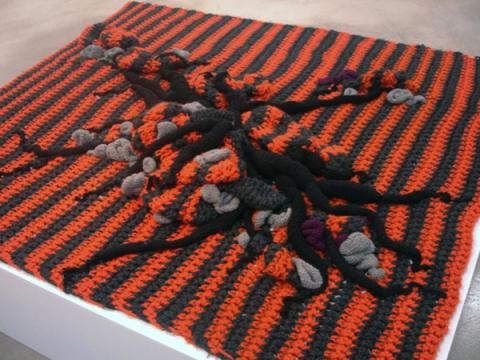
Using crochet, I simulated some of the behaviors of tumoral and cancerous cells, such as abnormal excessive replication and metamorphic appearance. The knitting mimics the way healthy tissue, metaphorically illustrated by the regular stitches, appears disfigured when the disease infiltrates its weaving.
Silvia Rigon is an Italian artist and designer. She has a background in Painting from the Academy of Fine Arts of Venezia (Italy), and an MFA from the Department of Design| Media Arts at UCLA. Silvia’s artistic investigation combines elements her deep training in traditional fine art techniques and education, and her professional experience as a graphic and digital designer. The content of her pieces often refers to the notion of “monstrosity”, especially manifested in historical iconography and myths, as a way of unveiling the ambivalence and paradoxes underling our perception of the time in which we live. Her work has been exhibited in such venues as: The Metropolitan Museum of Photography in Tokyo, Japan; The Center for Contemporary Art in Tallin, Estonia; Lamec: Laboratorio per L’Arte Contemporanea in Vicenza, Italy; Lamparna 93 in Labin, Croatia. www.silviarigon.com
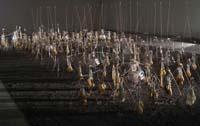
A hybrid lattice topography will be assembled at the California NanoSystems Institute, during the UCLA Art | Sci Center 2008 Symposium: Body Art Disease. The work will be composed of a lightweight sculptural field housing arrays of organic batteries. acting as a primitive 'geotextile' that might reinforce new growth. This system will support a dense series of very thin whiskers and low-power miniature lights, pulsing and vibrating in slight increments. Weak electrical charges are generated by copper and aluminum electrodes immersed in vinegar within latex bladders, working in concert with miniature microprocessors. The 'life' of the organic system will shift and erode during the symposium event. In installation workshops participants will work together in preparing the Endothelium sculpture. The work will include assembly of lightweight wood, paper and metal elements combined with miniature microprocessor and mechatronic components transported from the studio in Toronto. No prior experience is required.
Philip Beesley practices digital media art and experimental architecture in Toronto. His work in the last two decades has focused on field-oriented distributed sculpture and landscape installations.. In parallel with his sculpture practice he teaches architecture at the University of Waterloo School of Architecture in Cambridge, Ontario and is co-director of Waterloo’s Integrated Centre for Manufacturing, Visualization and Design, a facility combining high-performance computing, advanced visualization and digital fabrication. 2008-9 installations are slated for Montreal's Champ Libre, Pratt/Brooklyn, Linz Austria, CITA/Royal Academy Denmark and Surrey Gallery of Art, BC. His publications include North House (CDRN 2008), Maison Solaire (CDRN 2008), Mobile Nation (OCAD, 2007), Hylozoic Soil (Riverside, 2007), Ourtopias: Cities and the Role of Design (Riverside, 2007), Future Wood (CDRN, 2006), Responsive Architectures (Riverside, 2005), a chapter of Extreme Textiles (Smithsonian/Cooper Hewitt, 2005) and the cover feature AD Magazine Design through Making. (Wiley Academy 2005). Sculpture in upcoming publications include Interactive Art (Silver ed., Princeton, 2008), Digital Practice Now (Spiller, Wiley, 2008), Installations by Architects (Bonnemaison, Princeton, 2008), Persistent Modeling (Ayres, Architectural Design, Wiley, 2009). Beesley co-chaired the conferences Expanding Bodies: Art, Cities, Environment (ACADIA Halifax 2007), Responsive Architectures: Subtle Technologies (Toronto, 2006); Fabrication: Examining the Digital Practice of Architecture (Waterloo and Toronto, 2004), On Growth and Form: The Engineering of Nature (Cambridge, 2002). Distinctions for his work include the Prix de Rome in Architecture (Canada).
Hayley Isaacs is an associate of Philip Beesley Architect Inc. who has played key roles in conception and production of sculptures, books and buildings including Hylozoic Soil (Montreal, 2006), Ourtopias (Riverside, 2007), North House and Maison Solaire (CDRN, 2008). She holds a Master of Architecture from the University of Waterloo and her focus combines industrial design and exhibitry, graphic design and architecture.
New York, NY — One of the world’s leading art-science organizations, Art & Science Collaborations, Inc. (ASCI), opens their 10th annual, international, digital print exhibition, this year dedicated to exploring the use of imagination on behalf of our planet. "The world will not evolve past its current state of crisis by using the same thinking that created the situation," said Albert Einstein. By utilizing the almost limitless possibilities of digital imaging technologies, the artists in Digital’08: Imagination On Behalf Of Our Planet are contributing new perspectives on the diverse issues surrounding our planet’s current environmental crisis.
On view from October 4, 2008 through January 25, 2009 at the New York Hall of Science in Queens, Digital’08 is the result of an international “open call” that invited entrants to examine their environmental concerns, indulge their fantasies, and then share their digital visions of how a sustainable future might look.
“… we hoped that artists might propound possible solutions to environmental issues. Instead, by and large, we were presented with fresh approaches to framing the problems. But the reframing of a problem can often be a first step towards a solution,” says Digital’08 co-juror, John Michael Gorman who is an author, curator, and Director of The Science Gallery at Trinity College, Dublin, Ireland.
And Cynthia Pannucci, Digital’08’s other juror, and the artist-Founder/Director of ASCI, believes that “Artists today play an important role in society by creating art that: provokes thought, helps raise awareness, provides new perspectives, gives hope, seeks a higher consciousness, and on occasion, proposes new solutions.”
In this exhibition, you are presented with images reflecting on our environmental stewardship [or lack thereof] that explore topics running the gamut from: physical and digital recycling, as well as an imaginative, new alternative energy source; the fragility of nature in relation to its sustainability and ours; the promises of science and biotechnology, and even the healing power of music; the sad loss of our “natural heritage” marked in time; while from less down-to-earth perspectives come suggestions of there being more to “matter” than meets the eye; as well as the celebration of a more holistic, cosmic consciousness that sees man as “part of” rather than “separate from” nature.
Participating artists & scientists include: Lindsay Bloxam, Christine Chin, Roger Ferragallo, Nathaniel Freeman, Jessica Gross, Stephen Harrison, Nicole Hatanaka, Joseph Ingoldsby, Katherine Kollins, Robin Michals, Steve Miller, Edward Ramsay-Morin, Hugh O'Donnell, Ruth Parish, Rachel Simmons, Lily Smernou, and Mark Stock.
The New York Hall of Science is one of the most renowned hands-on science and technology centers in the United States, featuring more than 400 hands-on exhibits exploring the wonder and excitement of biology, chemistry and physics. The museum is open: Tuesday – Thursday 9:30 am – 2 pm, Friday 9:30 am – 5 pm (free 2 – 5 pm), and Saturday & Sunday 10 am – 6 pm (free Sunday 10 – 11 am), and is located in Flushing Meadows Corona Park in Queens, NY. Call (718) 699-0005 for directions or visit their website at: www.nyscience.org/visitor_info/directions
This exhibition charts the artistic and scientific explorations of German artist Maria Sibylla Merian (1647--1717) and her daughters Johanna Helena and Dorothea Maria. Enterprising and adventurous, these women raised the artistic standards of natural history illustration and helped transform the field of entomology, the study of insects. The exhibition presents books, prints, and watercolors by Merian and her contemporaries and features one of the greatest illustrated natural history books of all time, The Insects of Suriname.
Violent Nature - Adialog with evolved colonial aerospace industries from past millennia
Chris Csikszentmihalyi
Edmund Ming-Yip Kwong
Exhibition Dates: December 1 - December 29, 2007
Opening Reception: Saturday, Dec 1 from 6 - 8 PM
Violent Nature is an exhibition of installation and video by Chris Csikszentmihályi and collaborator Edmund Ming-Yip Kwong. This project is made possible with generous support from the Rockefeller Foundation and the Daniel Langlois Foundation for Art, Science, and Technology
"The theme of mastery in the literature of technology is even more evident with regard to Western man's relationship to nature. Hence there are seldom any reservations about man's rightful role in conquering, vanquishing, and subjugating everything natural. This is his power and his glory. What would in other situations seem rather tawdry and despicable intentions are here the most honorable of virtues. Nature is the universal prey, to manipulate as humans see fit." - Langdon Winner, Autonomous Technology
Chris Csikszentmihályi (USA) directs the Media Lab's Computing Culture group, which works to create unique media technologies for cultural applications. He has labored in the intersection of new technologies, media, and the arts for 15 years, lecturing, showing new media work, and presenting installations on five continents and one subcontinent. He is a currently a fellow at the Radcliffe Institute, and was a 2005 Rockefeller New Media fellow. Csikszentmihályi's last solo exhibition was at the Location 1 Gallery in New York's Soho. He toured museums and nightclubs with his mechanical hip-hop device, DJ I, Robot, which was nominated for the Best Artistic Software award at Berlin's Transmediale. A previous piece, Natural Language Processor, was commissioned by the KIASMAMuseum in Helsinki, Finland. The catalog for his installations Skin and Control is published by Charta, and he served on the National Academy of Science's ITand Creativity panel. Csikszentmihályi received an MFAfrom the University of California at San Diego, and a BFAfrom the School of the Art Institute of Chicago.
Edmund Ming-Yip Kwong (Hong Kong) is an artist and architect studying at the Massachusetts Institute of Technology. He has worked at the design office YungHo Chang in Beijing, and his work has been exhibited at Venice Biennale 10th International Architecture Exhibition, Cities, Architecture and Society 2006, the Toronto design show in 2006, and PRC at Boston University in 2007. Kwong's architectural work is focused on material research and design applications for lightweight construction.He has developed ultra-lightweight furniture, new techniques for the application of plywood -- a way for him to participate in reducing the environment footprint of everyday objects. Kwong has a BAfrom the University of Toronto.


 Rebeca Méndez was born in 1962 in Mexico City. She graduated from Art Center College of Design, Pasadena in 1984 (BFA) and in 1996 (MFA). She has participated in numerous exhibitions worldwide and her work is represented in public and private collections including the San Francisco Museum of Modern Art, The National Design Museum, New York, Denver Art Museum, and Museo Jose Luis Cuevas, Mexico City. Recently her work was exhibited at the Pompidou Centre in Paris as part of the exhibition ‘Morphosis: Continuities of the Incomplete.’ She currently lives and works in Los Angeles.