WEDNESDAY AT 2PM PDT AT UCLA EDA- Experimental Digital Arts
Broad Art Center, 1250, 240 Charles E Young Dr N, Los Angeles, CA 90095
In 2016, David Roy founded a space agency called BLACKNASA. He considers the process of making art “a practice of freedom that should never be estranged from everyday life.” Working with photography, sculpture, music, and technological installations, his mission is to conduct ‘rocket science’ on multiple levels, including “through the design, fabrication, and launching of rockets,” and “interventions in public space.”
David Roy is a multidisciplinary artist and educator from Los Angeles, California. His work, which spans performance, photography, sculpture, music, and technology is guided by the declaration of art as a practice of freedom that should never be estranged from everyday life. In 2016, he founded a space agency called BLACKNASA, with the mission of promoting the use of rockets for peaceful purposes only by conducting rocket science; both technical and social, through the design, fabrication, and launching of rockets, as well as interventions in public space. Since its inception, he has expanded BLACKNASA into an umbrella organization – to address its original purpose, and possibilities beyond.
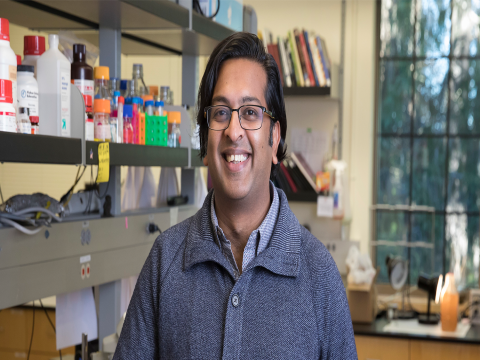
Dan has a mission to inspire where art and science meet. He is currently Professor of Developmental, Molecular and Chemical Biology (since 2001) working on Cancer Biology and Dean of the Graduate School of Biomedical Sciences at Tufts University (since 2017).
Dan is rare in that he has had a parallel career in the visual arts. He is also adjunct professor of Drawing and Painting at the School of the Museum of Fine Arts (Boston) where he will teach a course on How the Brain Perceives Art. His art practice uses scientific materials as new art media (liquid nitrogen, elements of the Periodic Table, magnetic fields) to express things that have inspired him in science from childhood to the present day.
Dan has shown this work widely including Harvard University, Massachusetts State House, Boston Convention Center, Aidekman Arts center (Slater Concourse), the French Cultural Center, Whitehorse Cultural Center (Yukon), the Danforth Art Museum, the Museum of the National Center for Afro-American Artists, the Ontario Science Centre, the Peabody Essex Museum and the Boston Museum of Science. He leads workshops and gives lectures at institutions around the world including The Cooper Union (New York) and University of Geneva (Switzerland). He is especially concerned with increasing diversity giving workshops to students from disadvantaged communities including the Boston Arts Academy and Josiah Quincy Middle School.
Click Here to Learn more and Schedule a free consultation with ArtSci advisor: https://sciartsummer.com
Science, Technology, Ecology, Arts and Mindfulness
– non linear quantum STEAM for the future leaders and teachers who will inherit the Earth. Our lessons are BOTTOM UP — just like nature works and we move back and forth between analogue and digital. We start with nano and end up in space — having fun all along the way — as we believe PLAY and collaboration are the key.
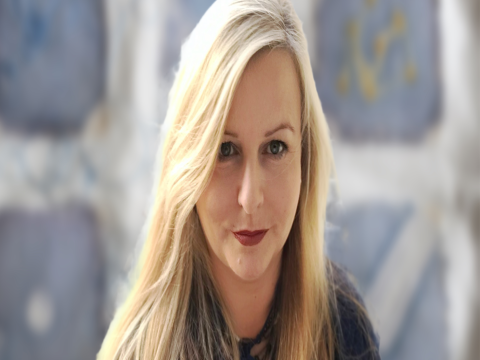
Amy Myers (b. 1965, Austin, TX), select exhibitions Berkshire Museum MA, Malin Gallery NYC, Mary Boone Gallery NYC, Suzanne Vielmetter Los Angeles Projects, Danese Gallery NYC, Rhona Hoffman Gallery Chicago IL, Dunn and Brown Contemporary Dallas TX, Fort Wayne State University Detroit, MI, Atlanta Center for Contemporary Art, The Museum of Fine Arts Houston TX, Nerman Museum of Contemporary Art KS, MOCA Hudson Valley, Greenville County Museum of Art NC, Sweeney Art Museum at California State University CA, Pomona College CA, Telfair Museum of Art TN, and Gallery Momo Tokyo Japan, and American Academy in Rome. Works collected in Solomon R.Guggenheim Museum, Pérez Art Museum Miami, California State University Art Museum, Fort Wayne Museum of Art, Greenville County Museum of Art, Hudson Valley MOCA, Museum of Fine Arts TX, Nerman Museum of Contemporary Art. Myers’ artworks have been cited in ARTFORUM, The New York Times, Hyperallergic, Artnews, Art in America, and BOMB.
Ted Victoria Using low-tech tools like homemade projectors and a camera obscura, Ted Victoria creates illusory images and installations known for their lifelike qualities. For example, with Infestation(2009), Victoria transformed a museum facade into an aquarium brimming with sharks; it was actually projections of brine shrimp swimming around in small aquariums on the inside of every window. Likewise, in a series of intricate projections mimicking boxed displays, Victoria questioned perceptions of reality: what appeared to be framed objects (a ring, a feather, a pair of pliers) in motion were actually reflections of the objects’ image created on glass, made possible by a hidden construction of lights, timed motors, lenses, and mirrors. The effect is that the isolated objects—truly seeming as if they were contained in the boxes—come across as simultaneously disconnected from reality and very real.
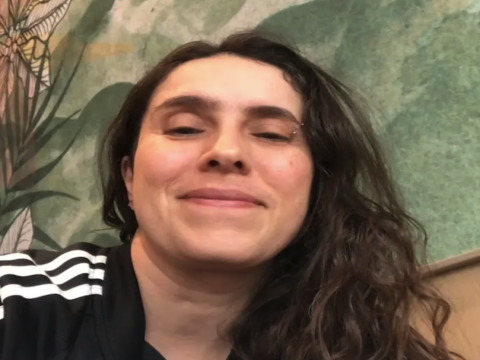
Patricia Cadavid is an immigrant, artist, and researcher born in Colombia. Her work looks at the relationships and effects of coloniality in new media and sound from the migratory experience and decolonial & anti-colonial thinking.
Student at the Interface Culture Lab (Kunstuniversität Linz), she received her BFA from the Universidad de Castilla-La Mancha and her MA from the Universitat Politècnica de València, multimedia &Visual arts program. Her work has been exhibited in different festivals such as Ars Electronica (Austria), ADAF (Greece), or the NIME and SEAMUS conferences as well as in several spaces in Chile, Mexico, Spain, Germany, and Colombia.
Knotting the memory//Encoding the Khipu_
From a decolonial perspective, I am working on the vindication of the memory contained in the ancestral interfaces of the Andes of South America taken away by colonization and their connections with art and science. I reuse this ancient technology in new artistic processes related to sound, New Interfaces for Musical Expression (NIMEs), tangible live coding, and multimedia performance.
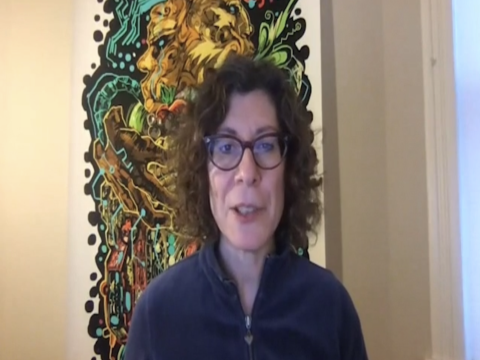
Ann McCoy has studied alchemy for fifty years. This talk will focus on the relationship of alchemy to the dream world, and how alchemy is a symbolic language which describes processes occurring below the threshold of consciousness. In a time when we are seeing a war on psyche, especially in the approaches advocated by many MFA programs and the art world in general, this lecture will be on the importance of the realm of the unconscious. For McCoy connecting art to the inner life is of supreme importance. Current mechanical, material, and positivist models feel lacking, and critical theory will hopefully give way to more expansive ways of viewing art making that have greater dimensionality. This lecture will be on McCoy’s own work and the relationship of her work to alchemy and dreams.
About Ann McCoy
Ann McCoy is a New York-based sculptor, painter, and art critic, and Editor at Large for the Brooklyn Rail. She was awarded a John Simon Guggenheim Foundation Fellowship in 2019. She taught art history, the in the graduate design section of the Yale School of Drama until May 2020, and the Art History Department at Barnard College from 1980 through 2000.
Ann McCoy’ work is included in the following collections: the Metropolitan Museum of Art, the Los Angeles County Museum of Art, the Hirshhorn Museum and Sculpture Garden, the Museum of Modern Art, the National Gallery of Australia, the Roy L. Neuberger Museum, the San Francisco Museum of Modern Art, and the Whitney Museum of American Art, among others. Ann McCoy has received the following awards: the John Simon Guggenheim Fellowship, the Asian Cultural Council, the Pollock Krasner Foundation, the Adolph and Esther Gottlieb Foundation Award, the Award in the Visual Arts, the Prix de Rome, the National Endowment for the Art, the Berliner Kunstler Program D.A.A.D..
Ann McCoy worked with Prof. C.A. Meier, Jung’s heir apparent for twenty-five years in Zurich She has studied alchemy since the early seventies in Zurich, and Rome at the Vatican Library.
About Gerald De Jong:
Gerald De Jong has a background in computer science and combinatorics from University of Waterloo, and has been a freelance software builder for decades in the Netherlands. He encountered the works of Fuller and Snelson early on, and over the years has developed several generations of an open source software model called Elastic Interval Geometry to enable playing with spatial geometry in general and tensegrity in particular. The latest manifestation of EIG is available on the web and in the last two years Gerald has evolved the code into a tool to guide the actual building of physical tensegrity objects. These new tensegrity structures exhibit a level of intricacy and complexity that was unaccessible to the previous generations who could not use computational design. He has built a number of tensegrity pieces based on his technique of prefabricated slack tension networks combined with compression bars that extend to tighten the structure.
Presented at Pratt Institute’s Manhattan Gallery and curated by Ellen K. Levy, a multimedia artist, scholar, and past president of the College Art Association, “From Forces to Forms” explores the nature of form by engaging with the potent forces and processes of nature. By investigating how physical laws shape living and nonliving forms alike — ideas first proposed by D’ Arcy Thompson in his classic tome “On Growth and Form” (1917) — the exhibition explores universal principles of organismic development while delving into the flux and perturbations that characterize life today.
Reflecting Pratt Institute’s commitment to interdisciplinarity, “From Forces to Forms” features works by 19 artists and designers whose practices draw from both art and science and articulate a shared commitment to creating a more sustainable world. These works consider the implications of form generation through a variety of media (from analog to digital), at different scales (from subatomic to macroscopic), and in varied contexts (from prebiotic to ecosystems).
Third Episode "Repairing Nature" will feature:
Lillian Ball
Ursula Endlicher
María Elena Gonzalez
Marta de Menezes and María Antonia Gonzalez Valerio
Christy Rupp
Victoria Vesna
Pratt Manhattan Gallery, now on the ground floor!
Presented at Pratt Institute’s Manhattan Gallery and curated by Ellen K. Levy, a multimedia artist, scholar, and past president of the College Art Association, “From Forces to Forms” explores the nature of form by engaging with the potent forces and processes of nature. By investigating how physical laws shape living and nonliving forms alike — ideas first proposed by D’ Arcy Thompson in his classic tome “On Growth and Form” (1917) — the exhibition explores universal principles of organismic development while delving into the flux and perturbations that characterize life today.
Reflecting Pratt Institute’s commitment to interdisciplinarity, “From Forces to Forms” features works by 19 artists and designers whose practices draw from both art and science and articulate a shared commitment to creating a more sustainable world. These works consider the implications of form generation through a variety of media (from analog to digital), at different scales (from subatomic to macroscopic), and in varied contexts (from prebiotic to ecosystems).
Second Episode "Morphogenesis" will feature:
Ricci Albenda
Gemma Anderson
Janet Echelman
Haresh Lalvani
William Lamson
Oliver Laric