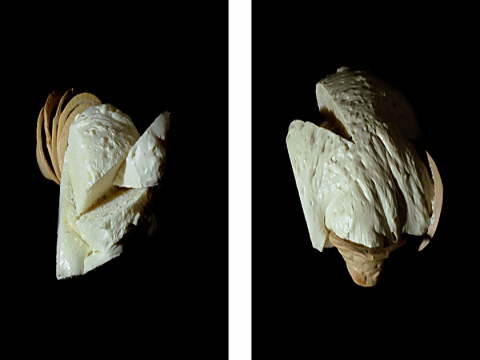
Presented at Pratt Institute’s Manhattan Gallery and curated by Ellen K. Levy, a multimedia artist, scholar, and past president of the College Art Association, “From Forces to Forms” explores the nature of form by engaging with the potent forces and processes of nature. By investigating how physical laws shape living and nonliving forms alike — ideas first proposed by D’ Arcy Thompson in his classic tome “On Growth and Form” (1917) — the exhibition explores universal principles of organismic development while delving into the flux and perturbations that characterize life today.
Reflecting Pratt Institute’s commitment to interdisciplinarity, “From Forces to Forms” features works by 19 artists and designers whose practices draw from both art and science and articulate a shared commitment to creating a more sustainable world. These works consider the implications of form generation through a variety of media (from analog to digital), at different scales (from subatomic to macroscopic), and in varied contexts (from prebiotic to ecosystems).
First Episode "Laws of Nature" will feature:
Tauba Auerbach
Adam Brown and Robert Root-Bernsteir
Todd Siler
Paul Thomas
Meredith Tromble
The first section of the exhibition is composed of works by artists who explore basic forces of nature and the behavior of entities that are often placed, unattended, in the background. The artists emphasize the activation of life, often constructing their own methods. Like Thompson, they look at the intersection of physics and chemistry. probing the boundaries between the animate and inanimate, and they consider the available sources of energy to initiate the transition. The late chemist Robert Shapiro, who embarked on a lifelong search for life's origins, pointed to the necessary conditions: "You need a compartment, you need a source of energy, you need to couple the energy to the chemistry involved, and you need a sufficiently rich chemistry to allow for this network of pathways to establish itself. Having been given this, you can then start to get evolution.'
Amir Abo-Shaeer and Emily Shaeer are a husband-and-wife team working to transform education. Their particular passion is STEAM education and ensuring that young people are invited – and prepared – to shape these fields in the future. To that end, they founded the Dos Pueblos Engineering Academy (DPEA) in 2002. It is a four-year pathway program in a public high school in California that serves over 400 students annually, 50% of whom are young women. In the context of this program, students use specialized technology, tools and equipment to design and create kinetic art. For their capstone project, students create ambitious, interactive, exhibits that have been featured in professional galleries including the San Francisco Exploratorium, the Santa Barbara Museum of Art, and The Wolf Museum of Exploration + Innovation (MOXI).
Currently, Amir and Emily are working to establish a first-of-its-kind Center for Creative Learning on their high school campus. This new facility will house original exhibits designed and fabricated by students in a large gallery, and it will enable a re-envisioning of the way that students’ time during the school day is harnessed for authentic community engagement and contribution.
Amir graduated from UCSB with a Bachelor’s degree in Physics and Master’s degrees in Mechanical Engineering and Education. Before becoming a teacher, Amir was a mechanical engineer working on research and development in academia, the aerospace industry, and the telecommunications industry. Amir was named a MacArthur Fellow in 2010, and is the recipient of numerous education awards.
Emily graduated from UC Santa Barbara with a Bachelor’s degree in Literature and a Master’s degree in Education. She also graduated from UC Irvine with a Master’s degree in English. Emily began teaching in 2001 and has taught Language Arts, Student Leadership, and English as a Second Language in grades 7-12. She works as the Program Director and Development Manager for the DPEA, and is strongly committed to being a change agent in education.
Collaboration between Franz J. Gießibl and Gerhard Richter
"First View inside an Atom"
Join us for a conversation with physicist
Franz J. Gießibl about his upcoming book on Art/Science collaboration with Gerhard Richter
moderated by James K. Gimzewski, FRS,
UCLA Art Science center scientific director
Wednesday, FEB 09, 2022
10am PST, 1pm EST, 7pm CET
Kristin Jones maintains both studio and public practices, working collaboratively across disciplines to create site-specific, time-based projects that frame natural phenomena against the built environment. With a deep commitment to public projects and the belief that art is a powerful vehicle for urban renewal and environmental awareness, Jones has spent her career creating large-scale collaborative works for the public domain. Jones was a member of the ‘Dream Team’ for the master plan for Hudson River Park. She has devoted more than 16 years to the founding of the Rome-based non-profit TEVERETERNO. By partnering with a treasury of artists, colleagues and the City of Rome to raise awareness of the Tiber River, Jones directed and facilitated programs for its protection and revitalization. Her installations, works on and paper and time-lapse photography have been exhibited internationally. Jones holds a BFA in Sculpture from the Rhode Island School of Design and an MFA from the Yale School of Art and Architecture. She is the winner of three Fulbright Fellowships and is a Fellow of the American Academy in Rome. She is currently based in New York City.
**IMAGE CREDIT- OCULUS: Collaborative work for the Pantheon in Rome, Italy, 2000 - present - Proposed installation by Kristin Jones with nighttime projection composed by Michael Benson from digital images collected with the CFHT telescope.
Robertina Šebjanič is an internationally awarded artist, whose work revolves around the biological, chemical, political and cultural realities of aquatic environments and explores humankind’s impact on other species and on the rights of non-human entities, while calling for strategies emphatic towards other species to be adopted. In her analysis of the theoretical framework of the Anthropocene, the artist uses the term ‘aquatocene’ and ‘aquaforming’ to refer to humans’ impact on aquatic environments. Her works received awards and nominations at Prix Ars Electronica, Starts Prize, Falling Walls.
This major exhibition of art, science, design, music and philosophy invites you to experience different global perspectives on our shared planet, and consider Earth as a community we all belong to. Interactive experiences, immersive installations and digital works come together to take you on a journey of self-reflection, discovering how technology can connect us to the natural world and leaving you feeling empowered to make positive change.
Artists, activists, researchers, writers, designers, scientists and more highlight the need to work across borders and disciplines to urgently tackle climate change together. By reigniting respect for our beautiful and complex planet Our Time on Earth will challenge your existing opinions on the most important issue of our lifetime.
[ALIEN] STAR DUST: Signal to Noise has evolved from a site-specific installation into a global, collaborative and participatory virtual guided meditation bringing participants into a space of healing and transcendence through visuals and vibrations. Due to times of crisis and quarantine it became evident that the connection is more vital than ever and stardust became the medium and the metaphor for contemplation and connectivity.
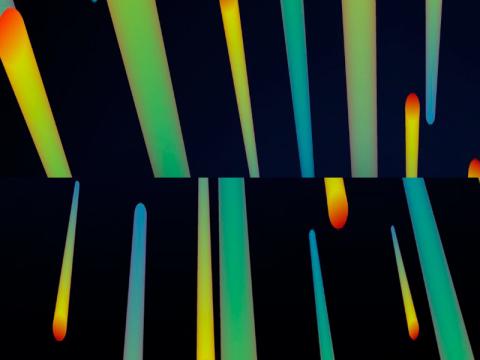
This meditation is created by the artist specifically for CYFEST-13 and will focus on the Chelyabinsk meteor that fell in 2013. Audiences are guided to follow the breakup of the meteor and stay centered as all falls apart, and the star dust is mixed up with various anthropogenic dust. Before the meditation, there will be a talk about the project followed by Q&A after the collective gathering of minds.
Media artist Eli Joteva laid down in an MRI scanner for hours to obtain the material for her digital artwork IntraBeing. It shows oversised organs and highly complex webs of nerves that move meditatively and mysteriously right before the viewer’s eyes.
Developed during her residency at Fraunhofer MEVIS, Eli Joteva has been tackling science-related themes for some time: she incorporates quantum mechanics and neurophysics influences into her work. She uses sophisticated imaging techniques such as infrared cameras and laser scanners to create her digital installations.
CYFEST is one of the biggest international festivals of media art in Eastern Europe, founded by a group of independent artists and curators in Saint Petersburg in 2007. CYFEST unites art professionals, programmers, engineers and media activists all over the world, expands territories and possibilities of contemporary art, intertwining it with various disciplines of science and technology.
CYFEST is an exceptional international project. In 2019, the festival projects were presented at the leading cultural institutions in New York, Rome, Venice, Moscow and St. Petersburg.
Saint Petersburg CYFEST will engage largest city’s art spaces, including Saint Petersburg Stieglitz State Academy of Art and Design, Annenkirche (Lutheran Church of Saint Ann), and the State Hermitage Youth Educational Center.
CYFEST 12 also includes a broad exhibition, video, sound and educational programs.
Alvaro Azcarraga
UCLA MFA student Design Media Arts major
Jennifer Hotes
UCLA Undergraduate student Design Media Arts major
Matt Teeter
UCLA Undergraduate student- Biochemistry major
John Brumley
PhD, Human Informatics- University of Tsukuba, Japan
Nidhi Vinod
PhD, Evolutionary Biology- UCLA
In the spirit of ideas worth spreading, TED has created a program called TEDx. TEDx is a program of local, self-organized events that bring people together to share a TED-like experience. Our event is called TEDxManhattanBeach, where x = independently organized TED event. TED Talks video and live speakers will combine to spark deep discussion and connection in a small group. The TED Conference provides general guidance for the TEDx program, but individual TEDx events, including ours, are self-organized. Please join us at our event.