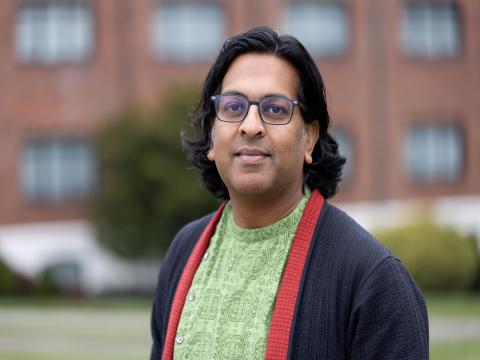
In this episode, Takashi joins us from Tokyo, Japan, and addresses how he interprets the global events occurring right now and how one event can shift everything. He discusses one of his interests in going beyond human perception in both spatial and temporal scales, and how it is applicable to the pandemic. Two pressing issues we face today, climate change and the virus, are both beyond our temporal perception, as climate change is on a scale of thousands of years, and in comparison, the virus is a few nanometers in length. Takashi also contemplates how we can bridge the large gap between the digital and real worlds, something increasingly prevalent in the time of the pandemic as we work from home, thinking about how Coronavirus is a good opportunity to update the way we understand things. He asks how we can understand the world without storytelling and discusses how AI has the ability to help us go beyond storytelling. This engaging conversation about the role of the intersection between art and science in current events is not to be missed.
Takashi Ikegami is a professor in the Department of General Systems Sciences at the University of Tokyo. His works encompasses both the arts and sciences and deal with complex systems and artificial life. He received his doctorate in physics from the University of Tokyo in 1989. His research is centered on complex systems and artificial life, a field that aims to build a possible form of life using computer simulations, chemical experiments, and robots. Some of these results were published in the book Life Emerges in Motion in 2007. Takashi Ikegami frequently attends the International Conference on Artificial Life, and gave the keynote address at the 20th Anniversary of Artificial Life conference in Winchester, UK. He is also a member of the editorial boards of Artificial Life, Adaptive Behavior, BioSystems, and Interaction Studies.
We are humbled to be joined by George Quasha who immediately invites viewers and listeners to slow down and settle into their bodies and place and truly listen. Quasha is careful and conscious with his speech and semiotics believing in the power of language as a world-maker or world-breaker. In this regard, Quahsa speaks with "quantum awareness" understanding that, even down to the molecular level, interactions are the basis for our language and therefore our existence. Throughout this conversation he tells stories of his experiences working trans-disciplinarily as a poet, artist, musician and how those multiple places allow for open-ended understandings of the surrounding world. He discusses his own theories and revolutions rooted in his artistic and mindful practices.
We are so fortunate to talk with Kathy Brew, award-winning artist and film-maker, who joins us today to talk about her most recent work as Curator with the National Coalition Against Censorship (NCAC) for the Annual Benefit: Let me Speak. This annual benefit provides funding and resources for artists facing issues of censorship and to continue to facilitate freedom of expression and creativity. Kathy and Victoria discuss the particular potency of the auction this year, as well as how the newly virtual format provides greater accessibility and expansiveness. Listen to find out more about this imperative work!
Joining us for our 24th episode is Dr. Carlo Ventura from Bologna, Italy, who takes us on an incredible journey through his work with vibrational healing on a deep, cellular level. Ventura guides us first through his spiritual practice - discussing the scientific necessity for consciousness and mindfulness and for positioning ourselves within the context of the physical universe. We are then given a wonderful presentation of his work and research in cellular vibrational healing bearing witness to the power of sound.
Andrew is a lifelong scientist and seasoned entrepreneur recognized for his ability to transform fundamental scientific discoveries into real-world innovations. He is known for pioneering research advances in the life sciences and co-founding multiple technology, biotechnology and healthcare startups, playing pivotal roles in corporate growth, strategic investments and executive leadership. He has led the strategic development and execution of corporate R&D programs, manufacturing processes and quality system operations. Andrew also actively supports other emerging companies in life sciences as an advisor, consultant, and angel investor.
This discussion explores critical environmental concerns regarding air quality and pollution. Featuring insights from Andrea Polli, Suzanne Paulson, and Victoria Vesna, the session delves into the scientific and artistic visualization of air quality data. It highlights the health impacts of particulate matter, including cardiovascular risks, and the challenges in monitoring and regulating ultrafine particles.
John Halpern a.k.a. John DiLeva Halpern is a documentary filmmaker, protest art provocateur, and performance artist based in New York City. He is known for cultural activism and documentaries about art, artists, and Tibetan Buddhism.
Monica C. LoCascio (b. 1984) is a transdisciplinary artist focusing on the materiality of invisible phenomena. Her works arrive as artifacts of her material and theoretical research on memory, microbiology, theoretical physics, and hierarchies of knowledge and power. She pairs fermented bio-materials, salvaged fiber, and heritage craft techniques with industrial and salvaged materials to examine the tension between the fluidity and vulnerability of the lived human experience and the systems and institutions that contrast it.
Dr. Wells, a psychiatrist and health services researcher, has led a number of studies of how variations in health services systems and financing affect clinical care as well as on the use of Community-Partnered Participatory Research to address disparities in access to and outcomes of services for depression.
Gustavo Alfonso Rincon, presenting a new media arts and architectural conceptual research framework that reflects on how A.I. is transforming artistic, design, and media knowledge creation. A focus on the intersection between the arts, architecture, and sciences will be explored as a new paradigm for change.
While A.I. is making humanity confront radical, accelerated change in all aspects of human existence. We are at a crossroads engaging contemporary stories which signal possible futures that capture our attention and influence our present lives. Many questions are left unasked, but answers reside in our individualistic lived experiences, both physical and virtual. Images, geometry, sounds, text, and worlds are found in our information-driven world. Everything is information. Space is information. Complex systems are information. Our world outside of our understanding is information. All movement around that links all of humanity together, commerce, the internet, and telecommunications.
Rincon will also reflect on his broader research trajectory, including his interdisciplinary arts, design, and media practice, curatorial projects, and educational design research work, including online research community building.