UCLA Art Sci Center, directed by Victoria Vesna, is dedicated to pursuing and promoting the evolving "Third Culture" by facilitating the infinite potential of collaborations between (media) arts and (bio/nano) sciences.
Currently, UCLA ArtSci Center is seeking a Graduate Research Assistant with funding to be an integral part of our Media Arts MFA Program.
The Master of Fine Arts in Media Arts is a rigorous three-year program that focuses on each individual's personal and creative development within the context of media arts. Each student works toward an individual thesis project that incorporates research and theoretical exploration of a topic of their choice, with the goal of producing a refined body of work that culminates in an MFA exhibition. DMA graduate students come from many fields and artists from diverse backgrounds including the visual arts, sciences, and engineering are encouraged to apply.
The program is focused on preparing students in three primary ways. First, through the acquisition and development of technical and craft-based skills in various related media. Second, by building a thorough theoretical foundation in media history and theory, and supporting each student’s journey in developing their own unique discursive framework through writing, research, and interdisciplinary engagement with other departments at UCLA. Finally, by helping students hone a sophisticated and compelling body of work, through critiques, seminars, exhibitions and one-on-one mentorship.
01.04.24 --- Application deadline for Fall 2024 Admission
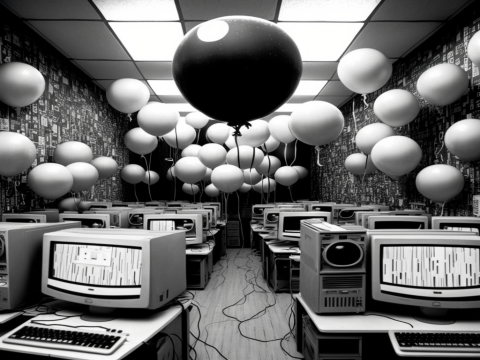
AI visualizations in art represent a digital renaissance, blending precision of algorithms with imagination of artists. The process of prompt input and interaction between artist and machine is a testimony of new artistic frontiers.
This workshop will explore various AI-powered software tools for generative art creation for images, videos and audio. We will focus on practical skills, including crafting effective prompts to produce optimal generative artworks. Interactive sessions will provide hands-on experience, enabling attendees to develop and refine their AI-generated art pieces with precision and creativity. Discover the transformative potential of AI in both artistic expression and professional applications, and envision the future shaped by advancements from OpenAI and more.
To prepare for the workshop, please sign up for free trials of Midjourney, RunwayML, and Stable Audio. This will allow us to test them together during the session.
-----
Yuting Tao [Intern at UCLA ArtSci Center and Harvestworks NY] is a forward-thinking media artist based in New York City, who investigates social interventions through immersive installation with narratives, AI and extended reality. With a focus on narrative development, Yuting endeavors to bridge the generational divide between Gen Z and earlier generations, fostering a shared understanding and appreciation for the evolving societal narrative.
Yuting earned her Bachelor’s degree from UCLA Design Media Arts program, where her passion for blending traditional storytelling with contemporary digital mediums flourished. Her academic pursuits sharpened her skills in AR and VR, paving the way for her innovative approach to narrative exploration. Currently, she is investigating on the application of generative art.
Yuting’s artistic journey is a testimony to her belief in the power of technology as a tool for social preservation and adaptation. Through her work, she creates not just visually enthralling experiences, but also platforms for dialogue, reflection, and connection across generational lines.
-----
Rooted on a thorough understanding of the history of philosophy, this work builds on critical and ontological thought to interpret the concept of life that underscores first-hand dealings with matter and experimentation. The book breaks new ground on the issue of animality and delivers fresh posthumanist perspectives on the topics addressed. The authors embark on a deep ontological probe of the concept of medium as communication-bridging and life-bearing. They also take on the concept of performativity as biotechnological art.
The book includes concrete, well-documented case studies and shows how certain narratives and practices directly impact ideas surrounding science and technologies. It will interest philosophers in art and technology, aesthetics, ontology, and the life sciences. It will also engage art practitioners in art and science, curators and researchers.
Co-hosts: Satinder Gill and Victoria Vesna and Chrysi Nanou
AnotherAI.art: Decolonising Art Ecosystem PART II
When: November 30, 2023, 6-8 pm GMT | 11 am - 1 pm PST
Where: Online via ZOOM
Co-hosts: Victoria Vesna (Art|Sci Lab, UCLA), Satinder Gill and Chrysi Nanou (Centre for Music and Science, Cambridge University)
On June 1st, we held the first part of this LASER series on Decolonising AI with guests Amir Baradaran and Mashinka Fruits Hakopian. See HERE
This LASER discussion is based on a special issue on Deconolonising AI with the AI & Society Journal, co-curated by Victoria Vesna and Amir Baradaran. Artists are well-placed to ask critical questions of access, agency, and equity in relation to AI and its impact on the art ecosystem. These include the encoding of bias and the (digital) marginalisation of various social groups. Such critique of AI allows for the emergence of knowledge that stems from, or lives through, cosmologies marginalised or erased through colonisation, and presents how they can be re-centered through processes of decolonisation, i.e. through questioning patterns of power shaping our intellectual, political, economic and social worlds.
FEATURING:
- Minne Atairu
- George Zarkadakis
Minne Atairu is an interdisciplinary Artist, and doctoral student in the Art and Art Education program at Teachers College Columbia University. Minne's research emerges at the intersection of Machine Learning, Art Education and Hip-Hop Pedagogy. Through the use of Artificial Intelligence (StyleGAN, GPT-3), Minne recombines historical fragments, sculptures, texts, images and sounds to generate synthetic Benin Bronzes which often hinge on questions of repatriation, and post-repatriation. For Minne's residency at the movement lab, she will focus on developing a CGI film using motion and facial capture technologies.
George Zarkadakis is an accomplished writer of both fiction and non-fiction, as well as a science communicator, Artificial Intelligence engineer, futurist, and digital innovation expert. He authors books spanning both fiction and non-fiction genres. Additionally, he collaborates with both private and public organizations, aiming to transform business and democratic institutions in the context of the Fourth Industrial Revolution. Zarkadakis perceives the arts, humanities, natural sciences, and engineering not as isolated fields, but as a continuous spectrum, constantly enhanced by human creativity and imagination.
The authors/speakers will present a diversity of cultural perspectives on the issues around AI and Art, from their personal experiences as artists. Each artist demonstrates their active engagement with technology, interrogating its implications and conjecturing about our potential futures with it. At its core, the future of these developments remains an enigma; and artists see their ‘role’ as being to caution [us] about potential pitfalls and to present alternative approaches to artificial intelligence. In their discussion they expose us to multiple points of view on Artificial Intelligence and offer an opportunity to consider another “I” in AI.
–––
The Leonardo/ISAST LASERs are a program of international gatherings that bring artists, scientists, humanists and technologists together for informal presentations, performances and conversations with the wider public. The mission of the LASERs is to encourage contribution to the cultural environment of a region by fostering interdisciplinary dialogue and opportunities for community building to over 50 cities around the world. To learn more about how our LASER Hosts and to visit a LASER near you please visit https://leonardo.info/laser-talks @lasertalks
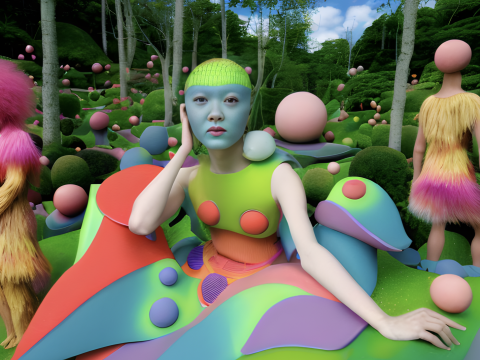
Image: Minne Atairu, Portraits of Mami Wata wearing a fishscale-inspired hairdo accentuated with blonde, synthetic hair extensions [2023].
UCLA ArtSci Center is excited to take part in TEDx Manhattan Beach again, showcasing the "Alien Star Dust" AR experience. This year’s event, FUTURE SHAPING, will be held on November 4, 2023, at Mira Costa High School.
ALIEN STAR DUST: https://alienstardust.com
DataX Workshops series Designing our Future: Environment, Community and Technology
DataX presents Professor of Information Studies, Ramesh Srinivasan, in conversation with an interdisciplinary set of UCLA professors focused on environmental issues such as climate change and their intersection with questions of justice and voice in relation to the proliferation and use of big data. This new series will feature a hallmark event each quarter! Registration required.
The event will have an online as well as in person* option.
Guest Faculty:
Victoria Vesna is an Artist and Professor at the UCLA Department of Design Media Arts and Director of the Art|Sci center at the School of the Arts and California Nanosystems Institute (CNSI).
Karen McKinnon is an Assistant Professor in the Institute of the Environment and Sustainability, the Department of Statistics and Data Science, and the Department of Atmospheric and Oceanic Sciences all at UCLA.
Alesia Montgomery is an Assistant Professor at UCLA’s Institute of the Environment and Sustainability and in African American Studies.
*In person location: Collins Conference Room, James West Alumni Center on the UCLA campus.
Image credits: Tenzin Choegyal. Photo courtesy of the artist
Simone Giuliani (photo 1). Photo by Marlon Krieger
Simone Giuliani (photo 2). Photo courtesy of the artist
Tsering Dorjee Bawa. Photo by Sej Saraiya
WACD 2023 will be in Portland Oregon on October 12 and 13.
WACD is a Chapter of the Association of Biomolecular Resource Facilities. The WACD aims to create a regional group of professionals from research focused institutions who share an interest in the development, operation and advancement of innovative, cost effective high-throughput technologies and services. Annual meetings will provide an opportunity for the group to share experiences and challenges and to form relationships with peers they can connect with throughout the year on topics of interest.
Friday, October 13th
8:30-9:00 Welcome: Coffee & Pastries
9:00-10:30 Session 5: Cores for the Common Good – examples of cores influencing real world outcomes and demonstrating professional avenues and collaborations
Moderator: Isabelle Girard (UCD)
Speaker: Chris Harrington (OHSU) and Jackie Shannon (OHSU), “Cores in Support of Impactful Innovation: the Healthy Oregon Project”
Speaker: Brett Phinney (UCD), “Developing Proteomic Genotyping for the Common Good”
Speaker: Victoria Vesna (UCLA), “Visualizing Frequencies: Art and Science from Atomic to Cosmic Dimensions”
Tenzin Choegyal, Simone Giuliani, Tsering Dorjee Bawa, Christiana Polites, Victoria Vesna
The quintessential text, attributed to the eighth century Buddhist Vajra master Padmasambhava, provides insight and direct instructions on how to navigate through the stages of the Bardo, the intermediary state between life and death. According to the teachings of Tibetan Buddhism, the Bardo journey offers practitioners a precious opportunity to awaken to their true Buddha nature and find liberation from suffering.
Internationally acclaimed Tibetan singer/songwriter Tenzin Choegyal will be joined by award-winning composer Simone Giuliani on piano and actor, musician, and dancer Tsering Dorjee Bawa, performing the rare Black Hat masked ritual dance. The concert is narrated by Christiana Polites, director of Tibetan Medicine & Buddhist Center Pure Land Farms, with visuals produced by media artist and director of the UCLA Art | Sci Center, Victoria Vesna in collaboration with John Brumley and Dillon Bastan.
About the Artists
Tenzin Choegyal is a world renowned musician in the Tibetan tradition. The son of Tibetan nomads, he feels a particular connection to the music of the high Himalayan plateau. While proudly continuing the unbroken nomadic lineage which is central to his repertoire, Tenzin also embraces opportunities to take his music into more contemporary, uncharted territory, both in the studio and on stage. Tenzin has opened for His Holiness the Dalai Lama and collaborated with Philip Glass, Patti Smith, Anoushka Shankar, and Charlotte Gainsbourg. Alongside Jesse Paris Smith and Laurie Anderson, he recorded the 2021 Grammy-nominated Songs from the Bardo, released through Smithsonian Folkways. He also has nine independent albums, three with his fusion band Tibet2Timbuk2.
Tsering Dorjee Bawa is an award-winning artist who has been a Tibetan music and arts performer for almost three decades. He earned his master’s degree studying Tibetan secular dance and music at the Tibetan Institute of Performing Arts (TIPA), Dharamsala, India, where he was privileged to study under legendary artists. He has since traveled the world sharing his knowledge and performing Tibetan Opera, central Tibetan Step Dance, and Cham, a series of colorful, masked ritual dances. In addition to performing onstage from Seattle Children’s Theatre to Lincoln Center in New York, he has acted in several notable films, including the 1999 Oscar-nominated Himalaya, and My Son Tenzin (2017). Tsering resides in the Bay Area, where he has established a community school program to preserve Tibetan language, music, and dance for a new generation.
Simone Giuliani is a director, producer, and composer born in Florence, Italy, and based in New York and Los Angeles. He has worked with such artists as Andrea Bocelli, Wu-Tang Clan, Cibo Matto, Bebel Gilberto, and many more. He has collaborated with the London Symphony Orchestra and the Royal Philharmonic Orchestra, and directed a live concert for Pope Francis inside the Roman Forum. Giuliani is director of programs for MOMENT NYC, a music education non-profit presenting the history of music in New York City through performances in public schools. He is co-founder of Yangchenma Arts & Music, a community organization celebrating the richness and diversity of human cultures through their artistic and musical traditions.
This program is co-sponsored by the UCLA Art | Sci Center and supported by a grant from Lilly Endowment Inc.
"The California Spangled Cat is a completely new breed of American Domestic feline. All the genetic magic that produces the lush spotted coats of the world's big cats has been duplicated for the small, perfect bodies of these leopards for your living room."
On Tuesday, September 26th, from 2 to 7 pm, the California Snow Leopard will be visible through a telescope placed on the rooftop of the UCLA Planetarium, buzzing with dragonflies.
The little creature with leopard spangles on a white coat found its way into the world paired with an accompanying silver bowl through the 1986 Neiman Marcus Christmas Book, an American luxury mail-order catalog. Its creator, Hollywood screenwriter Paul Casey Jr., developed the exclusive animal as a living memorial to its endangered relatives in the wild.
Fur coats were offered for sale in the same catalog just a few pages away. In addition to the high price of $1.400, the delivery time for the cat, which was difficult to breed in its snow-white form, was 8 months. The cat only found few buyers, and gradually Casey had to refocus his excitable mind on the more promising among his many projects. Thus, the process of the little leopard’s vanishment already began when it was born.
According to The International Cat Association, it has fully disappeared by now, foreshadowing a tragic parallel to its big relatives. In cat breeder circles, sometimes grey or ruddy specimens still appear and are, like the original, called “California Spangled”.
The white variant—the snow leopard—whose birth under the Californian sun was certainly the least expected and who was not even pictured in said Christmas catalog, but only evoked in enthusiastic words, dissolves, however, every day a little more - a possible improbability or improbable possibility, as also its name fades away.
The rare chance to capture the phantom through a telescope was therefore unforeseeable and revives the idea that the animal could be of enchanted nature.
About the artist:
Christoph Kilian, *1983, studied media arts at the Bauhaus University Weimar and the Academy of Media Arts Cologne. He lives between Cologne, Salzburg and Los Angeles, where he completed a guest study program at the ArtCenter College of Design in 2014 and currently is artist-in-residence at the UCLA Art|Sci Center. In a cross-media play and clash with technology, he constructs machine fairy tales that - often on the verge of futility - trace the magical.