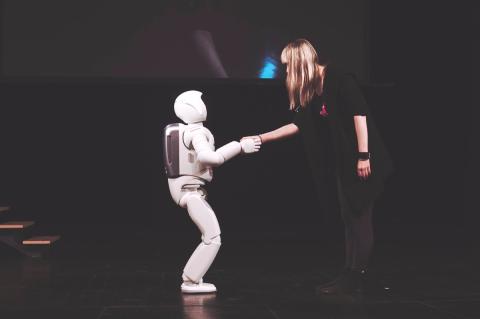
This question is at the core of human robot interaction, an inherently interdisciplinary research aspiration. Human robot interaction research brings together engineering and social science, cognitive science, neuroscience, ethics and arts. Humans have a strange response to things that are lifelike, but not alive. Robotics is as much a study of people as it is about robots; it requires us to reach insight into a new and dynamically changing relationship between human and intelligent machines. By creating robots, we can reflect humanity and subsequently we can understand humans better. Learning from human behavior is critical for developing robots for the real world.
In the lecture we will also discuss about Android Science. The development of robots that closely resemble human beings can contribute to cognitive research. The approach of cognitive science uses the android robot for verifying hypothesis for understanding humans. We call this cross interdisciplinary framework Android Science.
Maša Jazbec is an artist, curator and researcher. She holds a Ph.D. in human informatics, attained at the Univ. of Tsukuba (Virtual Reality Lab) in Japan and MA in interactive art, achieved at Interface Culture at the Univ. of Arts and Design Linz. She was a visiting researcher at Ishiguro Laboratory at ATR where has deepened her research in human-like robotics and android science also in practice. She is engaged to the vision and execution of the Trbovlje New Media Setting project in Slovenia, and was curating events integrating science, art and technology at the new media culture festival Speculum Artium. Her projects, exhibited as artworks, have always shown her understanding of new media as a research artistic practice, stemming from artistic and scientific thought, linked to the current situation in the contemporary society. Her latest research interests are mostly focused in social robotics and android science. She presented her research at conferences such as Computer Human Interaction, Human Robot Interaction, ISEA and System Man and Cybernetics IEEE. Currently she is leading DDTLab in Trbovlje, Slovenia. DDTLab is a research lab operating in the fields of cybernetics, virtualization, BCI systems, and robotics.
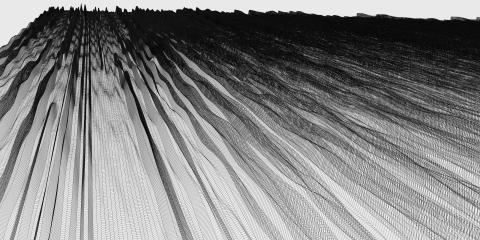
The Quantum Drawing workshop designed by Honorary Professor Paul Thomas would benefit scientists, physicists, artists and designers. The participants will explore via drawing concepts of John Bell’s 1964 provocation, to try and capture reality in the act of happening. Bell’s theorem was designed to prove or disprove the fundamental concepts of quantum mechanics. The Quantum Drawing workshop draws an analogous relationship with probability and uncertainty prevalent in science where the observer affects what is observed. The workshop questions the role of the observer influencing what is seen and experienced whilst measuring the world through drawn marks. By the act of drawing, the participants will question their roles in observing and measuring the world. Complex subjects such as delayed choice quantum erasure, probability, indeterminacy, entanglement, superposition and the classical-quantum divide will be explored through the traditional act of mark-making. When an artist makes a mark on a piece of paper through a process of summing all the probabilities of what they experience then the mark collapses the world down to a single state. Intentional repositioning and reshaping of science practices through art can promote exploration of different ways of visualising, perceiving, understanding, communicating and acting in the material world. In so doing this workshop becomes a model for facilitating transdisciplinary development of alternative domains and discourses that garner insights gained from perception, seeing with understanding.
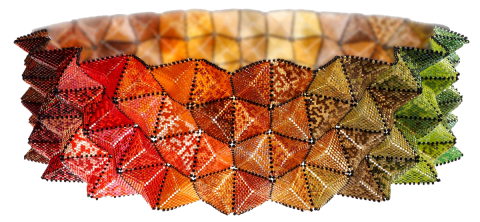
The most exciting aspects of our work on the beadwork team have been finding unexpected overlaps between the forms and shapes that leap from our hands to processes and structures from the natural world. Our methods of deconstructing our beadwork resemble the way the enzyme helicase unzips DNA, and our morphing surfaces take origami ideas to the study of metamaterials and analog computation. That we are studying these ideas in beads may sound odd, but not only does this study reflect the deep connection that human beings have with beads and beadwork, but beads (being individual units) fit perfectly with studies of the natural world as they easily stand in for numbers, pixels, atoms, or any smallest discrete unit of structure or calculation.
In this talk, I will show how we can physically build energy into beadwork, how repeating patterns or counts can combine into fantastically complex machines and objects of beauty, and how we have been able to enjoy living in a world based in creating art while still being able to contribute materially to scientific and mathematical exploration and discovery.
Kate McKinnon (she/they) is a researcher and co-founder of the UnLAB, a non-profit team currently based in Savannah, Georgia. The UnLAB is a multi-disciplinary group that seeks to develop and further ideas simply for the sake of learning. Current projects include advanced propulsion, the study of momentum and energy, aware architecture, human consciousness and QI (Questioning Intelligence, as opposed to AI, which stands for Artificial Intelligence). In addition to participating on the science teams, Kate leads the Contemporary Geometric Beadwork project, a ten year long open-source exploration of sewn beadwork that includes hundreds of thousands of beaders from diverse fields and hailing from over 30 countries. The team has published two books on the techniques they've developed to create geometric architecture and energetic forms, and they have a series of new books coming out soon showing a range of cycling linkages, morphing surfaces, and detailing their study of energetic lines, planes and forms.
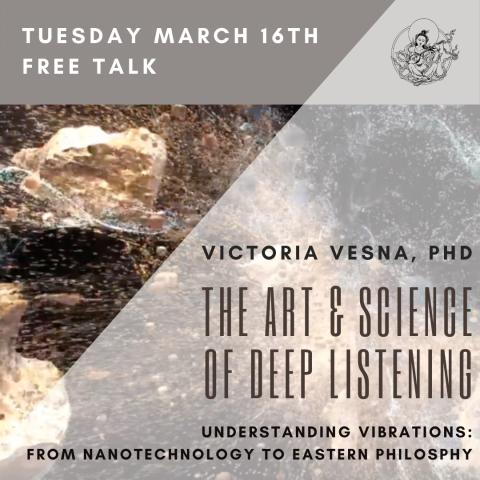
UNDERSTANDING VIBRATIONS: FROM NANOTECHNOLOGY TO EASTERN PHILOSOPHY A TALK WITH VICTORIA VESNA, PHD
In this talk, Dr. Victoria Vesna discusses vibrations from the point of view of visual and sound artists considering the scientific research into matter, brain waves, human and animal voice, environmental noise and outer space.
Quantum mechanics is based on music theory and nanotechnology is showing us the waves that underlie all matter which many Eastern philosophies have known for centuries. We need to learn to listen to the inaudible.
Jen Arch, Erkki Huhtamo, Christine Johnson, Christina Ramos
A collaboration between UCLA's Art|Sci Center and Washington University’s Center for the Humanities and Medical Humanities program, Screening Contagion invites you to a series of panel discussions on four films, with faculty drawn from a variety of disciplines. This week's panel will explore a classic of world cinema: Ingmar Bergman, The Seventh Seal (1957). How does our own pandemic moment inform how we view these films?
The way we, as humans, participate in the vibrational fields and flows of energy of the Planet Earth is embodied practice, even if the process often remains somewhat mysterious, unnoticed or unacknowledged. This workshop will explore how a human vocalization, which is nothing else than amplified and conscious breathing, can become a practice of inquiry into the planetary water cycle.
The human body is a fluid phenomenon, not only because the average amount of water in human organism ranges between 45-75%, depending on the particular organ or tissue (majority of which constitutes intracellular fluid), but also because it is incorporated into the planetary cycle, in which water constantly changes from liquid to vapor to ice, circulating around, through, and above the Earth. Through a simple act of breathing we may participate in the whole range of scales and time flows: for the terrestrial atmosphere, a given water molecule, the one we breathe in and breathe out as oxygen, might spend in the atmosphere 15,23 days on the average. What if the way we breathe and vocalize impacts the water cycles? Can we turn our bodies into water cycles measuring units and the instruments of cooperation with weather patterns? What if even the tiniest movement of the oxygen in our nostrils and lungs and even the slightest resonation of the vocal cords, chest, and abdomen can affect a rainstorm?
Meditating on such questions may provide an interesting departure point for both scientific inquiry and embodied practice of breathing and vocalizing.
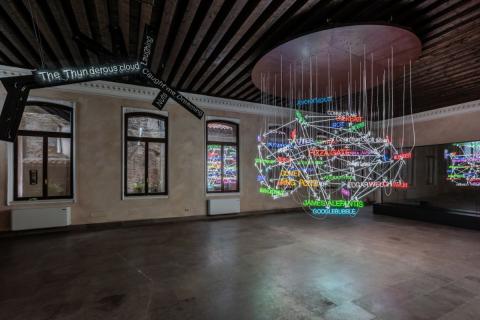
This pop-up studio visit, hosted by Victoria Vesna, will follow Neidich through his studio, video performances, neon sculptures and most recent paintings. Neidich will guide us through an entangled journey while he and Vesna discuss the history, context and processes involved.
ABOUT WARREN NEIDICH- Having studied photography, neuroscience, medicine and architecture, Warren Neidich brings to any discussion platform a unique interdisciplinary position that he calls “trans-thinking.” He currently uses writing, theory, and multimedia text-based neon sculptures to create cross- pollinating conceptual works that reflect upon situations at the border zone of art, science, politics and social justice. His performative and sculptural work the “Pizzagate Neon” (2018), a large hanging neon light sculpture, recently on display at the 2019 Venice Biennial, analyzed the relations of Fake News, the networked attention economy, accelerating technology, and their possible combined effect upon the architecture of the brain. His recent conceptual project Drive-By-Art (Public Sculpture in This Moment of Social Distancing) just opened on the South Fork of Long Island and Los Angeles to acclaim including reviews in The New York Times, Hyperallergic, The Art Newspaper, Time Out and Los Angeles Magazine. He is a former tutor at Goldsmiths College, 2004-2008 and professor of Art at Weissensee Kunsthochschule, Berlin, 206-2018. He has lectured at such institutions as Brown University, Harvard, GSD, School of the Chicago Art Institute, Columbia University, La Sorbonne, Paris viii, University of Oxford and Cambridge just to name a few. He is founder and director of the Saas-Fee Summer Institute of Art (2015-), a theory intensive postgraduate course that attracts students worldwide operating in Los Angeles, New York City and Berlin. This year it addressed the topic of Activist Neuroaesthetics a term he invented to express the power of art alter the socio-political cultural milieu and thereby mutate the conditions of the neural plastic brain with which it is entangled. His latest book The Glossary of Cognitive Activism was reviewed in the Los Angeles Review of Books.
“We’re all part of this swirl of change [..], and it’s very human.” Join us this week for a discussion with Monica C. LoCascio in her new studio space, surrounding her MA thesis - OUR BODY IS OUR ANCHOR TO THE PRESENT, an exploration of the epigenetics of trauma through sensation and the materiality of embroidery and biomaterials. Vesna and LoCascio discuss the impetus of the work and LoCascio expresses how she found rest, reflection, and meditation in this work during the events of the past year. This important work reflects the changing tides of our world over the past year, bringing together trauma and healing, body and spirit, rest and reflection.
Monica C. LoCascio is a mixed-media artist exploring the inherent powers of the body, energetic phenomena, and non-human biomaterials in their capacity to challenge established knowledge hierarchies. Informed by her own occult ritual practice and inspired by theoretical quantum physics, somatic trauma studies and therapies, and inclusive philosophy, her work arrives as artifacts of her material and theoretical research.
LoCascio’s work has been shown at the Museum of Natural History of Vienna, The Academy of Fine Arts Krakow, CERN, the Angewandte Innovation Lab and the Biennale Sessions at the Venice Biennale 2019. She recently completed her MA in Art & Science with distinction at the Universität für Angewandte Kunst in Vienna, Austria.
Under the Hood is a video series presented by the UCLA ArtSci Center that pops open the “hood” to reveal the mechanics and mechanisms of ArtSci projects. In these short interviews, you are invited to take a deep dive into the process of how these complex artworks are created. Through a practical break-down of the technology, software, and science behind these art-science features, you will gain understanding of how art-based research is practiced and applied. Under the Hood is a series that serves as a source of inspiration and information for anyone interested in understanding the inner-workings of the multidisciplinary projects at the ArtSci Center.
He discusses one of his interests in going beyond human perception in both spatial and temporal scales, and how it is applicable to the pandemic. Two pressing issues we face today, climate change and the virus, are both beyond our temporal perception, as climate change is on a scale of thousands of years, and in comparison, the virus is a few nanometers in length. Takashi also contemplates how we can bridge the large gap between the digital and real worlds, something increasingly prevalent in the time of the pandemic as we work from home, thinking about how Coronavirus is a good opportunity to update the way we understand things. He asks how we can understand the world without storytelling and discusses how AI has the ability to help us go beyond storytelling. This engaging conversation about the role of the intersection between art and science in current events is not to be missed.