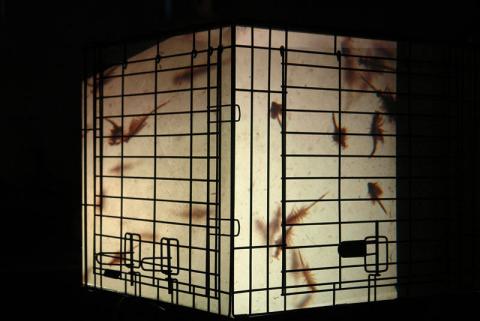
Ted Victoria Using low-tech tools like homemade projectors and a camera obscura, Ted Victoria creates illusory images and installations known for their lifelike qualities. For example, with Infestation(2009), Victoria transformed a museum facade into an aquarium brimming with sharks; it was actually projections of brine shrimp swimming around in small aquariums on the inside of every window. Likewise, in a series of intricate projections mimicking boxed displays, Victoria questioned perceptions of reality: what appeared to be framed objects (a ring, a feather, a pair of pliers) in motion were actually reflections of the objects’ image created on glass, made possible by a hidden construction of lights, timed motors, lenses, and mirrors. The effect is that the isolated objects—truly seeming as if they were contained in the boxes—come across as simultaneously disconnected from reality and very real.
Patricia Cadavid is an immigrant, artist, and researcher born in Colombia. Her work looks at the relationships and effects of coloniality in new media and sound from the migratory experience and decolonial & anti-colonial thinking.
Student at the Interface Culture Lab (Kunstuniversität Linz), she received her BFA from the Universidad de Castilla-La Mancha and her MA from the Universitat Politècnica de València, multimedia &Visual arts program. Her work has been exhibited in different festivals such as Ars Electronica (Austria), ADAF (Greece), or the NIME and SEAMUS conferences as well as in several spaces in Chile, Mexico, Spain, Germany, and Colombia.
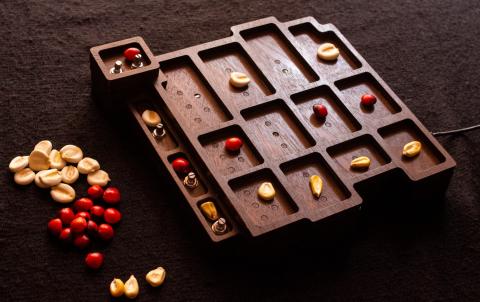
Knotting the memory//Encoding the Khipu_
From a decolonial perspective, I am working on the vindication of the memory contained in the ancestral interfaces of the Andes of South America taken away by colonization and their connections with art and science. I reuse this ancient technology in new artistic processes related to sound, New Interfaces for Musical Expression (NIMEs), tangible live coding, and multimedia performance.
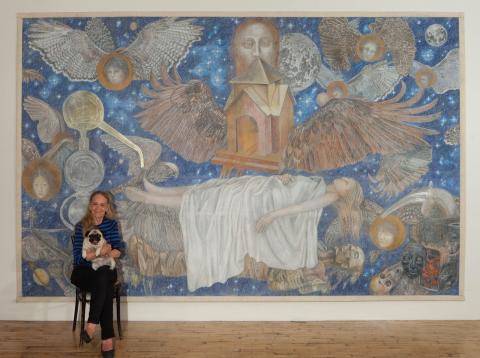
Ann McCoy has studied alchemy for fifty years. This talk will focus on the relationship of alchemy to the dream world, and how alchemy is a symbolic language which describes processes occurring below the threshold of consciousness. In a time when we are seeing a war on psyche, especially in the approaches advocated by many MFA programs and the art world in general, this lecture will be on the importance of the realm of the unconscious. For McCoy connecting art to the inner life is of supreme importance. Current mechanical, material, and positivist models feel lacking, and critical theory will hopefully give way to more expansive ways of viewing art making that have greater dimensionality. This lecture will be on McCoy’s own work and the relationship of her work to alchemy and dreams.
About Ann McCoy
Ann McCoy is a New York-based sculptor, painter, and art critic, and Editor at Large for the Brooklyn Rail. She was awarded a John Simon Guggenheim Foundation Fellowship in 2019. She taught art history, the in the graduate design section of the Yale School of Drama until May 2020, and the Art History Department at Barnard College from 1980 through 2000.
Ann McCoy’ work is included in the following collections: the Metropolitan Museum of Art, the Los Angeles County Museum of Art, the Hirshhorn Museum and Sculpture Garden, the Museum of Modern Art, the National Gallery of Australia, the Roy L. Neuberger Museum, the San Francisco Museum of Modern Art, and the Whitney Museum of American Art, among others. Ann McCoy has received the following awards: the John Simon Guggenheim Fellowship, the Asian Cultural Council, the Pollock Krasner Foundation, the Adolph and Esther Gottlieb Foundation Award, the Award in the Visual Arts, the Prix de Rome, the National Endowment for the Art, the Berliner Kunstler Program D.A.A.D..
Ann McCoy worked with Prof. C.A. Meier, Jung’s heir apparent for twenty-five years in Zurich She has studied alchemy since the early seventies in Zurich, and Rome at the Vatican Library.
About Gerald De Jong:
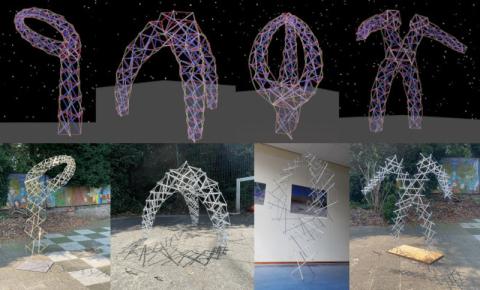
Gerald De Jong has a background in computer science and combinatorics from University of Waterloo, and has been a freelance software builder for decades in the Netherlands. He encountered the works of Fuller and Snelson early on, and over the years has developed several generations of an open source software model called Elastic Interval Geometry to enable playing with spatial geometry in general and tensegrity in particular. The latest manifestation of EIG is available on the web and in the last two years Gerald has evolved the code into a tool to guide the actual building of physical tensegrity objects. These new tensegrity structures exhibit a level of intricacy and complexity that was unaccessible to the previous generations who could not use computational design. He has built a number of tensegrity pieces based on his technique of prefabricated slack tension networks combined with compression bars that extend to tighten the structure.
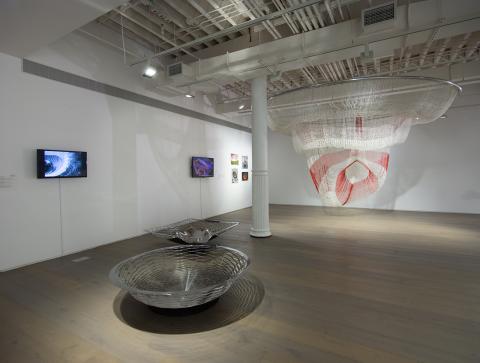
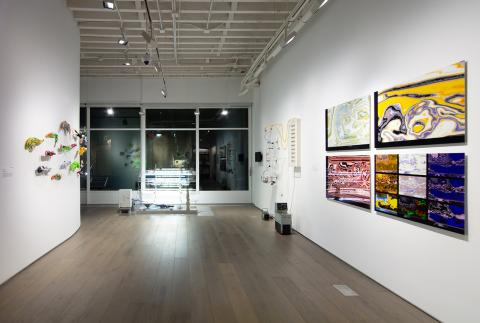
Presented at Pratt Institute’s Manhattan Gallery and curated by Ellen K. Levy, a multimedia artist, scholar, and past president of the College Art Association, “From Forces to Forms” explores the nature of form by engaging with the potent forces and processes of nature. By investigating how physical laws shape living and nonliving forms alike — ideas first proposed by D’ Arcy Thompson in his classic tome “On Growth and Form” (1917) — the exhibition explores universal principles of organismic development while delving into the flux and perturbations that characterize life today.
Reflecting Pratt Institute’s commitment to interdisciplinarity, “From Forces to Forms” features works by 19 artists and designers whose practices draw from both art and science and articulate a shared commitment to creating a more sustainable world. These works consider the implications of form generation through a variety of media (from analog to digital), at different scales (from subatomic to macroscopic), and in varied contexts (from prebiotic to ecosystems).
Third Episode "Repairing Nature" will feature:
Lillian Ball
Ursula Endlicher
María Elena Gonzalez
Marta de Menezes and María Antonia Gonzalez Valerio
Christy Rupp
Victoria Vesna
Pratt Manhattan Gallery, now on the ground floor!
Presented at Pratt Institute’s Manhattan Gallery and curated by Ellen K. Levy, a multimedia artist, scholar, and past president of the College Art Association, “From Forces to Forms” explores the nature of form by engaging with the potent forces and processes of nature. By investigating how physical laws shape living and nonliving forms alike — ideas first proposed by D’ Arcy Thompson in his classic tome “On Growth and Form” (1917) — the exhibition explores universal principles of organismic development while delving into the flux and perturbations that characterize life today.
Reflecting Pratt Institute’s commitment to interdisciplinarity, “From Forces to Forms” features works by 19 artists and designers whose practices draw from both art and science and articulate a shared commitment to creating a more sustainable world. These works consider the implications of form generation through a variety of media (from analog to digital), at different scales (from subatomic to macroscopic), and in varied contexts (from prebiotic to ecosystems).
Second Episode "Morphogenesis" will feature:
Ricci Albenda
Gemma Anderson
Janet Echelman
Haresh Lalvani
William Lamson
Oliver Laric
Presented at Pratt Institute’s Manhattan Gallery and curated by Ellen K. Levy, a multimedia artist, scholar, and past president of the College Art Association, “From Forces to Forms” explores the nature of form by engaging with the potent forces and processes of nature. By investigating how physical laws shape living and nonliving forms alike — ideas first proposed by D’ Arcy Thompson in his classic tome “On Growth and Form” (1917) — the exhibition explores universal principles of organismic development while delving into the flux and perturbations that characterize life today.
Reflecting Pratt Institute’s commitment to interdisciplinarity, “From Forces to Forms” features works by 19 artists and designers whose practices draw from both art and science and articulate a shared commitment to creating a more sustainable world. These works consider the implications of form generation through a variety of media (from analog to digital), at different scales (from subatomic to macroscopic), and in varied contexts (from prebiotic to ecosystems).
First Episode "Laws of Nature" will feature:
Tauba Auerbach
Adam Brown and Robert Root-Bernsteir
Todd Siler
Paul Thomas
Meredith Tromble
The first section of the exhibition is composed of works by artists who explore basic forces of nature and the behavior of entities that are often placed, unattended, in the background. The artists emphasize the activation of life, often constructing their own methods. Like Thompson, they look at the intersection of physics and chemistry. probing the boundaries between the animate and inanimate, and they consider the available sources of energy to initiate the transition. The late chemist Robert Shapiro, who embarked on a lifelong search for life's origins, pointed to the necessary conditions: "You need a compartment, you need a source of energy, you need to couple the energy to the chemistry involved, and you need a sufficiently rich chemistry to allow for this network of pathways to establish itself. Having been given this, you can then start to get evolution.'
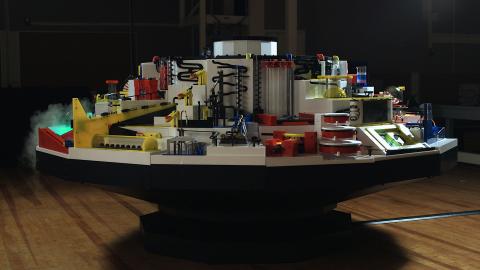
Amir Abo-Shaeer and Emily Shaeer are a husband-and-wife team working to transform education. Their particular passion is STEAM education and ensuring that young people are invited – and prepared – to shape these fields in the future. To that end, they founded the Dos Pueblos Engineering Academy (DPEA) in 2002. It is a four-year pathway program in a public high school in California that serves over 400 students annually, 50% of whom are young women. In the context of this program, students use specialized technology, tools and equipment to design and create kinetic art. For their capstone project, students create ambitious, interactive, exhibits that have been featured in professional galleries including the San Francisco Exploratorium, the Santa Barbara Museum of Art, and The Wolf Museum of Exploration + Innovation (MOXI).
Currently, Amir and Emily are working to establish a first-of-its-kind Center for Creative Learning on their high school campus. This new facility will house original exhibits designed and fabricated by students in a large gallery, and it will enable a re-envisioning of the way that students’ time during the school day is harnessed for authentic community engagement and contribution.
Amir graduated from UCSB with a Bachelor’s degree in Physics and Master’s degrees in Mechanical Engineering and Education. Before becoming a teacher, Amir was a mechanical engineer working on research and development in academia, the aerospace industry, and the telecommunications industry. Amir was named a MacArthur Fellow in 2010, and is the recipient of numerous education awards.
Emily graduated from UC Santa Barbara with a Bachelor’s degree in Literature and a Master’s degree in Education. She also graduated from UC Irvine with a Master’s degree in English. Emily began teaching in 2001 and has taught Language Arts, Student Leadership, and English as a Second Language in grades 7-12. She works as the Program Director and Development Manager for the DPEA, and is strongly committed to being a change agent in education.
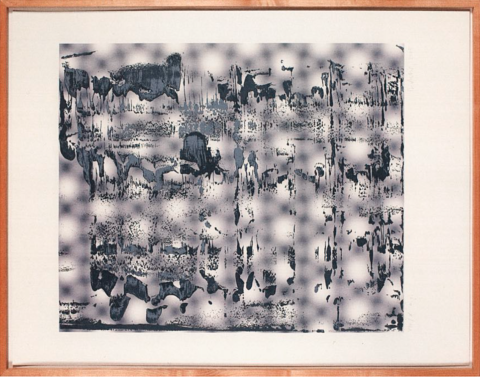
Collaboration between Franz J. Gießibl and Gerhard Richter
"First View inside an Atom"
Join us for a conversation with physicist
Franz J. Gießibl about his upcoming book on Art/Science collaboration with Gerhard Richter
moderated by James K. Gimzewski, FRS,
UCLA Art Science center scientific director
Wednesday, FEB 09, 2022
10am PST, 1pm EST, 7pm CET
Kristin Jones maintains both studio and public practices, working collaboratively across disciplines to create site-specific, time-based projects that frame natural phenomena against the built environment. With a deep commitment to public projects and the belief that art is a powerful vehicle for urban renewal and environmental awareness, Jones has spent her career creating large-scale collaborative works for the public domain. Jones was a member of the ‘Dream Team’ for the master plan for Hudson River Park. She has devoted more than 16 years to the founding of the Rome-based non-profit TEVERETERNO. By partnering with a treasury of artists, colleagues and the City of Rome to raise awareness of the Tiber River, Jones directed and facilitated programs for its protection and revitalization. Her installations, works on and paper and time-lapse photography have been exhibited internationally. Jones holds a BFA in Sculpture from the Rhode Island School of Design and an MFA from the Yale School of Art and Architecture. She is the winner of three Fulbright Fellowships and is a Fellow of the American Academy in Rome. She is currently based in New York City.
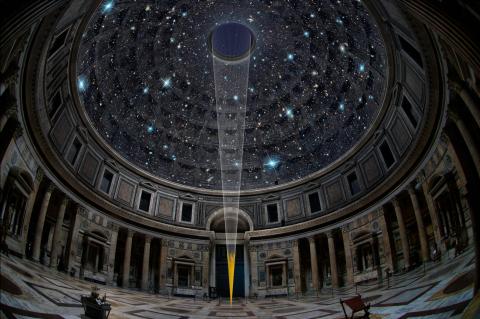
**IMAGE CREDIT- OCULUS: Collaborative work for the Pantheon in Rome, Italy, 2000 - present - Proposed installation by Kristin Jones with nighttime projection composed by Michael Benson from digital images collected with the CFHT telescope.