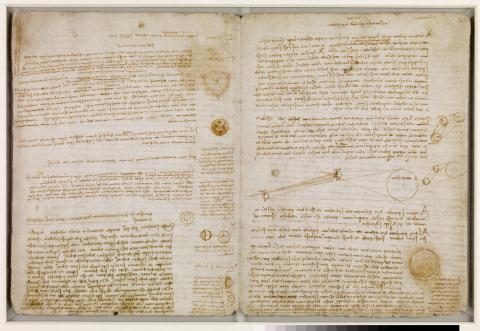
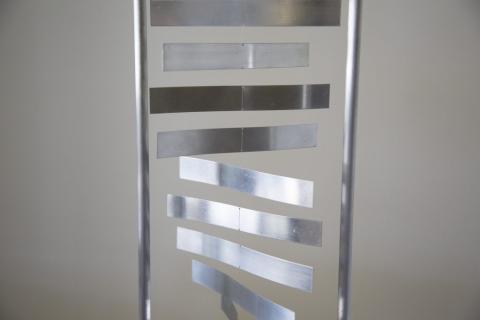
In a newly published study, Morteza Gharib, Professor of Aeronautics at Caltech, and two of his colleagues argue that Leonardo accurately estimated the gravitational constant two centuries before Newton without the aid of advanced mathematics (Leonardo 56/1, 2023, 21-27). Two specialists on Leonardo's writings discuss how Leonardo developed his ideas using a very different conceptual apparatus through a combination of words and images. Their conversation focuses on small-scale models and a variety of graphic techniques that are relevant to contemporary challenges ranging from fluid dynamics to determining the composition of the earth's core.
About the Speakers:
Matthew Landrus
Dr. Matthew Landrus is Supernumerary Fellow at the Faculty of History and Wolfson College, University of Oxford, where he teaches early modern history. He is also a Senior Lecturer at the Rhode Island School of Design. Most of his publications address the work of Leonardo da Vinci, particularly with regard to engagements between early modern visual culture, natural philosophy, engineering and technology. His books include The Treasures of Leonardo (2006), Leonardo da Vinci’s Giant Crossbow (2010), Le Armi e le Macchine da Guerra: il de re Militari di Leonardo (2010), and Instruments and Mechanisms: Leonardo and the Art of Engineering (2013).
Claire Farago
Claire Farago is Professor Emerita at the University of Colorado Boulder, where she taught Renaissance art, theory, and criticism for thirty years. She has held visiting professorships at UCLA, the University of North Carolina at Chapel Hill, the University of Melbourne, Australia, the University of York-U.K, the University of Zürich, and Smith College.
Often working collaboratively, she has published widely on topics ranging from Leonardo da Vinci’s writings to contemporary critical theory. Her book publications include Leonardo da Vinci’s Paragone: A Critical Interpretation (1992); the edited volume, Leonardo da Vinci and the Ethics of Style (2008); the edited volume, Re-Reading Leonardo: The Treatise on Painting across Europe 1550-1900 (2009); and The Fabrication of Leonardo da Vinci’s Trattato della pittura, with a scholarly edition of the editio princeps (1651) and an annotated English translation (2018), a collaboration with an international group of Leonardo scholars including Matthew Landrus. She currently resides in Los Angeles, where she is affiliated with UCLA.
Marisa Caichiolo is an artist and curator who studied art history and curatorial studies, she holds a PhD in art history and psychology.
Special Guests joining this session:
Shana Nys Dambrot / Art Critic
Doug Kacena / Director KContemporary Denver
Lidia Rubinstein / Art Collector Los Angeles
Ana María Mattei / Art Collector and Director AAL Magazine Chile
Her research focuses primarily on the impact on social and political changes in society. She focuses on cultural exchanges researching cultural production fluctuating between theory and practice.
Her curatorial projects have been shown internationally, including MUSA Museum of Arts of the University of Guadalajara(Mexico); Kirchner Cultural Center, Buenos Aires, (Argentina); DOX Center for ContemporaryArts, Prague (Czech Republic); Frost Science Museum, Miami (USA); PVAC PalosVerdes Art Center, Palos Verdes (California); Building Bridges Art Foundation,Los Angeles (California); KATARA Cultural Center, Doha (Qatar); Sharjah Museum of Contemporary Art, Dubai (United Arab Emirates); Anaheim Muzeo Museum andCultural Center, Anaheim (California); Telefónica Art Foundation, Santiago(Chile); among others.
She is the founder of Building Bridges International Art Foundation an international non-profit organization based in SantaMonica, Los Angeles County. The foundation is conceived to be a platform for critical thinking, and researching; local and international programs in LosAngeles; art residencies; and education programs among others.
She was part of the curatorial team for several international biennials, such as the Casablanca Biennale, Morocco;Sharjah Biennale, Sharjah, United Arab Emirates; Biennial of the Americas,Denver, Colorado; among others. She is also an active board member for Bugatti Foundation, Italy; Now Art LA, Los Angeles; and the Advisory Board of the DAP Program at The Broad, Los Angeles, also one of the jurors for Art of Recovery Program with the City of Santa Monica.
Starting with the late 1960s, artists have experimented with neurofeedback techniques to unveil that we can model our brainwave oscillations in relation to sounds and images that signal our transition into meditative states. Cultivating enchantment with the agency we can develop over unconscious processes and the non-verbal connections we mentally establish with others, they have invited us to reflect on the intrinsic alterity of our inner and outer worlds.
In this talk, I map out a genealogy of artworks informed by the aesthetics of neural networks and their dynamic behavior. I argue that the diversity of these practices results not only from the artists' original coupling of multiple media of expression but also from their imaginative blending of ideas derived from phenomenology, biofeedback experimentation, cybernetic theories, and Southeast Asian philosophies. I delineate a taxonomy of artworks encompassing neural data and I discuss how they catalyze speculative thinking about biological, cultural, and social entanglements.
About Cristina Albu:
Cristina Albu is an art historian, educator, and writer focusing on crossovers between contemporary art, cognitive sciences, and technology. She is Associate Professor of Contemporary Art History at University of Missouri-Kansas City (UMKC). Albu is the author of Mirror Affect: Seeing Self, Observing Others in Contemporary Art (Minnesota University Press, 2016) and the co-editor (with Dawna Schuld) of Perception and Agency in Shared Spaces of Contemporary Art (Routledge, 2018). Her writings have appeared in scholarly anthologies (e.g. Nervous Systems, Hybrid Practices, Framings, The Permanence of the Transient, Crossing Cultures) and journals (e.g. Afterimage, Artnodes, Camera Obscura, and the Comparative Media Arts Journal). At UMKC, Albu teaches courses on global contemporary art, participatory and site-specific tendencies, museum studies, and the role of emotion in art reception. She is currently working on a book which charts how artists have paired neurofeedback technology with sounds and video images to cultivate an embodied understanding of our entanglement in more or less visible systems.
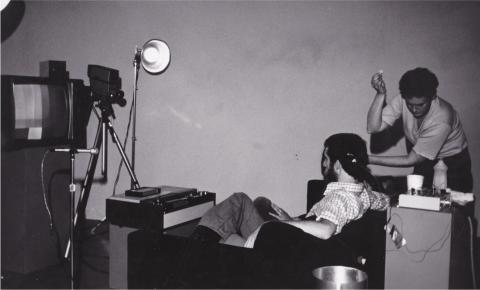
Image description: Nina Sobell, EEG: Video Telemetry Environment (also known as Brainwave Drawings, 1975), installation at the Contemporary Arts Museum, Houston.
Eli Joteva, Bulgarian media artist and graduate of UCLA's Design Media Arts MFA program, exhibits IntraBeing, an artistic exploration of the limits of perception and resolution in medical images. The immersive Installation with AR extension is the outcome of her »STEAM Imaging III« residency at the Fraunhofer Institute for Digital Medicine MEVIS, Germany.
What lies within the bounds of being? IntraBeing explores the boundaries of imaging the human body to imagine a limitless and intra-active sense of being. Eli Joteva worked remotely with researchers at Fraunhofer MEVIS to develop the work, exploring the capacities of medical imaging and simulation techniques to locate the enigmatic spaces that emerge at the limits of resolution and computation.
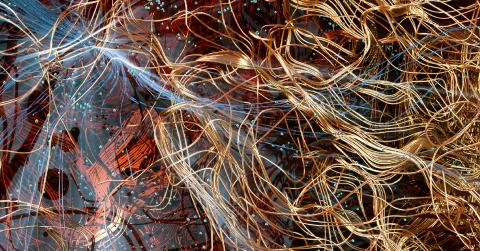
Artist in residence Eli Joteva performed a series of full-body MRI scans and diffusion tensor imaging (DTI) scans, which are usually only used to visualize connectivity in the brain, to instead reveal nerve fibers in the chest, pelvic region, and the feet of her own body. She was inspired by the fact that hydrogen atoms, on which MRI processing relies, are also in constant nanosecond flux and thus elude precise measurement. These components are key elements of the three-screen installation, complete with AR extension, which shows an oscillating internal landscape of hydrogen atoms, the nerves they flow along, and the magnetic potentials generated between them.
The starting point of the »STEAM Imaging III« residency was to bring artists together with scientists and school students to create broad access to a self-motivated exploration of topics in digital medicine through 10 STEAM evenings. The course was jointly created by artist Eli Joteva and scientists at Fraunhofer MEVIS. Boundaries of individual disciplines are crossed, flexible forms of learning and collaboration are developed, and skills are taught to deal effectively and critically with new technologies in digital medicine. The residency allows artists to exchange intensively with MEVIS experts and link their work with the latest scientific methods and approaches in digital medicine.
»STEAM Imaging III« was hosted by Fraunhofer MEVIS and Ars Electronica, Linz, Austria, in collaboration with the International Fraunhofer Talent School Bremen, the Schulzentrum Walle, Bremen, and the UCLA Art|Sci Center in Los Angeles, USA.
This exhibition will be on display for a week BY APPOINTMENT ONLY.
Email: artscicenter@gmail.com
In Marta de Menezes' public talk, attendees can expect to learn about the intersection of art and biology, and how these two fields can collaborate to create art based research work. De Menezes, who has worked in this field for over two decades, will share her insights on the opportunities and challenges of this interdisciplinary practice, as well as her experience in leading experimental art institutions in Portugal.
Marta Menezes is a renowned Portuguese artist with a degree in Fine Arts from the University of Lisbon and a Master's degree from the University of Oxford. She is also the director of Cultivamos Cultura, the leading experimental art institution in Portugal, and Ectopia, an organization dedicated to facilitating collaboration between artists and scientists.
Website link: https://martademenezes.com
The theme for Re–Fest 2023 is Re-New, which critically examines our culture’s obsession with newness. How can we prioritize ancestral knowledge, healing practices, and forgotten technologies in order to renew our relationship with creation and progress?
Festival sites in NYC and LA will feature exhibitions, performances, and conversations that will stream into our virtual venue, converging disparate disciplines, perspectives, and approaches in an effort to spark renewal.
Exhibition Artists:
Blair Simmons, Archive of Digital Portraits Cast in Concrete
Bobby Joe Smith III, Wókiksuye
Caco Peguero, FUTURING : Portable Park
Folly Feast Lab (Viviane El Kmati & Yara Feghali), Be.Longing XR
Iman Person
Jamison Edgar & Huntrezz Janos, White Man's Foot :))))))
Kate Parsons, Bloom AR
Kira Xonorika, Coral Reef, I am Presence
Laure Michelon, Machinic Reflection
Marcus Kuiland-Nazario & Paul Donald, Macho Stereo
Nicole Yi Messier & Victoria Manganiello (Craftwork Collective), Ancient Futures
Sarah Sweeney, A Conversation with My Deepfake Dad
Friday, May 5th, 2023 at 7pm CEST/1pm EDT/10am PDT
Artists joining us for this session are:
Quadrature,
Florian Voggeneder
The curators will also present the works of the artists in the chapter who won’t be able to join us: Agnes Meyer-Brandis, Lucy McRae, Anna Hoetjes, Ani Liu, Yi Weihan, Angel An
-
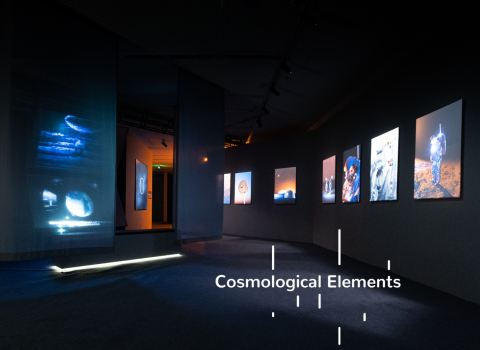
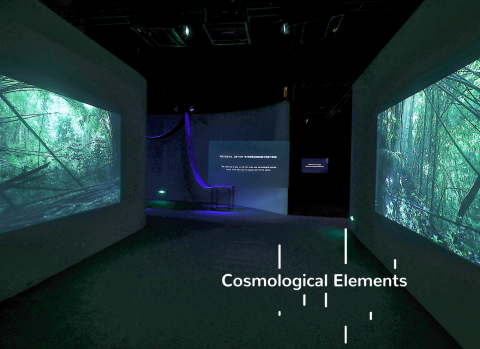
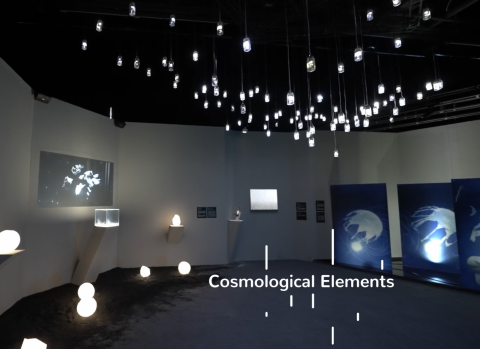
The upcoming episodes depart from an exhibition, Cosmological Elements, co-curated by Claudia Schnugg and Iris Long. From the micro scale to macro scale, the exhibition represents the relationship between cosmic space and human life from three unfolding chapters: “Hidden Dimension,” “Cosmic Ecology,” and “Floating Civilizations.” This exhibition discusses the idea of cosmological elements through several lenses: the lens of science that questions what are the elements that constitute objects in cosmos and the space in-between, elements that can also become central to study the universe and life on planet Earth, and furthermore, cultural and societal elements that constitute our perception of the universe, visions and desires.
CLICK HERE TO WATCH: https://vimeo.com/825619026?share=copy
PLEASE REGISTER TO JOIN: https://ucla.zoom.us/meeting/register/tJYpcOyvrzkvGN3XKMkUHjRY5D7cDit6H9...
More info: https://cosmoselements.art
How do we look towards the more-than-human world to inspire different notions of newness, rooted in cycles of birth and decay, rather than progress and invention? How can non-linearity in time assist us in finding alternative ‘new’nesses?
In this conversation hosted by Isabel Beavers (SUPERCOLLIDER) and Suzanne Anker (SVA BioArt Lab), artists will discuss art practices that deal with the concept of newness while also resisting colonality.
Participating artists include: Juan M. Villanueva (SVA Bio Art Lab), Nicholas DelCastillo (SVA Bio Art Lab), Ivana Dama (UCLA ArtSci Center), Alice Bucknell (SUPERCOLLIDER), and Kira Xonorika (SUPERCOLLIDER)!
Cath Le Couteur & Nick Ryan, Michèle Boulogne, Quadrature, Ranjit Bhatnagar
Artists joining us for this session are:
Cath Le Couteur & Nick Ryan,
Michèle Boulogne,
Quadrature,
Ranjit Bhatnagar
The curators will also present the works of the artists in the chapter who won’t be able to join us: Akoto Azuma, Jennifer Allora & Guillermo Calzadilla with Ted Chiang, Enjoy the Lunar Soil
-
The upcoming episodes depart from an exhibition, Cosmological Elements, co-curated by Claudia Schnugg and Iris Long. From the micro scale to macro scale, the exhibition represents the relationship between cosmic space and human life from three unfolding chapters: “Hidden Dimension,” “Cosmic Ecology,” and “Floating Civilizations.” This exhibition discusses the idea of cosmological elements through several lenses: the lens of science that questions what are the elements that constitute objects in cosmos and the space in-between, elements that can also become central to study the universe and life on planet Earth, and furthermore, cultural and societal elements that constitute our perception of the universe, visions and desires.
CLICK HERE TO WATCH: https://vimeo.com/821731311?share=copy
PLEASE REGISTER TO JOIN: https://ucla.zoom.us/meeting/register/tJ0rcuytrD8oGtdOgHUq9_X52gGTL5eSJ7...
More info: https://cosmoselements.art
Victoria Vesna, Daniela Brill Estrada, Eli Joteva, Angela Davies, Anna Hoetjes, Seph Li
These 3 episodes are based on an exhibition, Cosmological Elements, co-curated by Claudia Schnugg and Iris Long. The show took place at the Fosun foundation in Shanghai from December 2022 until February 2023. Many could not attend, so we are hosting this series to highlight the excellent works of artists who participated. Sessions in the Asia time zone will mirror these three.
Episode 1: Hidden Dimension on 21 April 2023 at 7pm CEST/1pm EDT/10am PDT
Host: Victoria Vesna
Moderation and Curators’ guided tour: Iris Long, Claudia Schnugg
Artists joining us for this session are:
Victoria Vesna, Daniela Brill Estrada, Eli Joteva, Angela Davies, Anna Hoetjes, Seph Li from OUTPUT
The curators will also present the works of the artists in the chapter who won’t be able to join us: Aoife van Linen Tol, Angel An, Shuchang Dong, Chen Mingqiang